
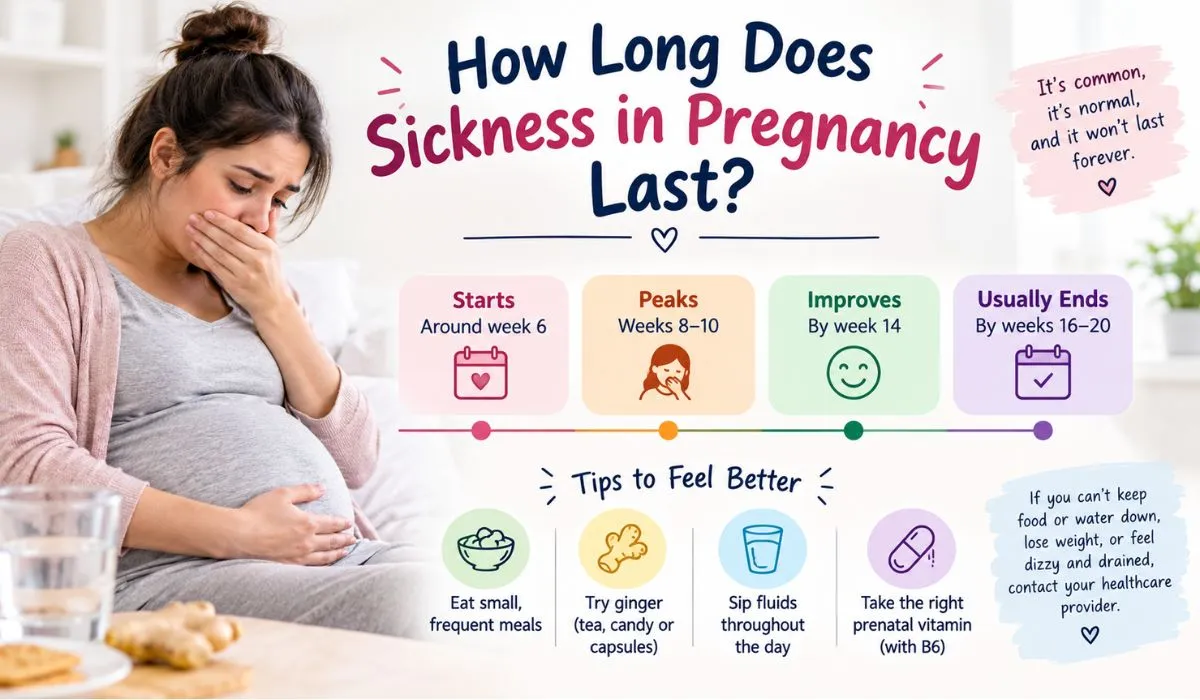
For most women, pregnancy sickness starts around week 6, hits its roughest patch around weeks 8-10, and starts letting go by week 14. But “most women” isn’t “every woman” — some feel fine by week 12, others are still queasy well into the second trimester, and that’s not a sign anything’s wrong.
Table of Contents
That churny, can’t-be-near-the-fridge feeling has a real name — nausea and vomiting of pregnancy, or NVP — though everyone just calls it morning sickness, even though it clearly doesn’t check the clock. It’s driven by hCG and estrogen surging through your system in early pregnancy, along with a sense of smell that suddenly seems to have superpowers. According to ACOG, somewhere between 70 and 80% of pregnant women deal with some version of this, so if you’re in it right now, you’re not the exception — you’re the rule.
There’s actually a small silver lining buried in here: some research links mild-to-moderate nausea with a lower risk of miscarriage, since it’s a byproduct of healthy hormone production doing its job. Not exactly comforting at 7am with your head over the sink, but worth knowing.
How This Usually Plays Out
Around weeks 4 to 6, most women notice the first wave — sometimes right when a period would’ve been due, sometimes a little later. A handful feel it as early as week 3. Then comes the tough stretch: weeks 8 through 10, when hormone levels are climbing fastest and nausea tends to peak. This is usually when it’s less “occasional queasiness” and more “constant background hum,” with or without actual vomiting.
The relief tends to arrive around weeks 12 to 14, as hCG plateaus and the placenta starts taking over hormone production. Plenty of women describe it almost like a switch flipping — one week miserable, the next actually hungry again. By weeks 16 to 20, most people are through the worst of it entirely.
But — and this matters — about 15 to 20% of women still feel some nausea into the second trimester, and a smaller number carry it on and off through the whole pregnancy. If that’s you, you haven’t done anything wrong, and your body isn’t broken. The “12 weeks and done” timeline everyone quotes is a average, not a promise.
When It’s Not Just Morning Sickness
There’s a line between ordinary pregnancy nausea and hyperemesis gravidarum (HG) — a more severe condition involving relentless vomiting, weight loss, and dehydration. HG doesn’t play by the usual calendar and often needs real medical support, sometimes IV fluids or prescription anti-nausea medication. If you can’t keep food or water down for a full day, you’re losing weight, or you feel dizzy and drained, call your provider. That’s not something to just wait out.
Getting Through It
You can’t speed up the timeline, but a few things genuinely help while you wait it out. Small, frequent meals beat three big ones — an empty stomach tends to make nausea worse. Ginger, whether as tea, candy, or capsules, has real evidence behind it. Fluids matter too, especially if you’re vomiting; small sips all day go down easier than trying to chug a glass at once. And the right prenatal vitamin, particularly one with a well-dosed form of B6, can quietly take the edge off for some women — worth a conversation with your provider rather than guessing on your own.
One thing to avoid: quitting your prenatal vitamin altogether because it seems to make things worse. Usually it’s a timing or format fix — taking it with food, or right before bed — rather than a reason to skip it entirely.
Quick Answers
When does morning sickness usually start?
Around weeks 5-6, sometimes as early as week 3-4.
When does nausea peak?
Typically weeks 8-10, when hCG is climbing fastest.
Is nausea in the second trimester normal?
Yes — about 1 in 5 women still feel some.
Does worse nausea mean a healthier pregnancy?
Not reliably. Severity varies widely; only persistent, severe vomiting (HG) needs medical attention.