
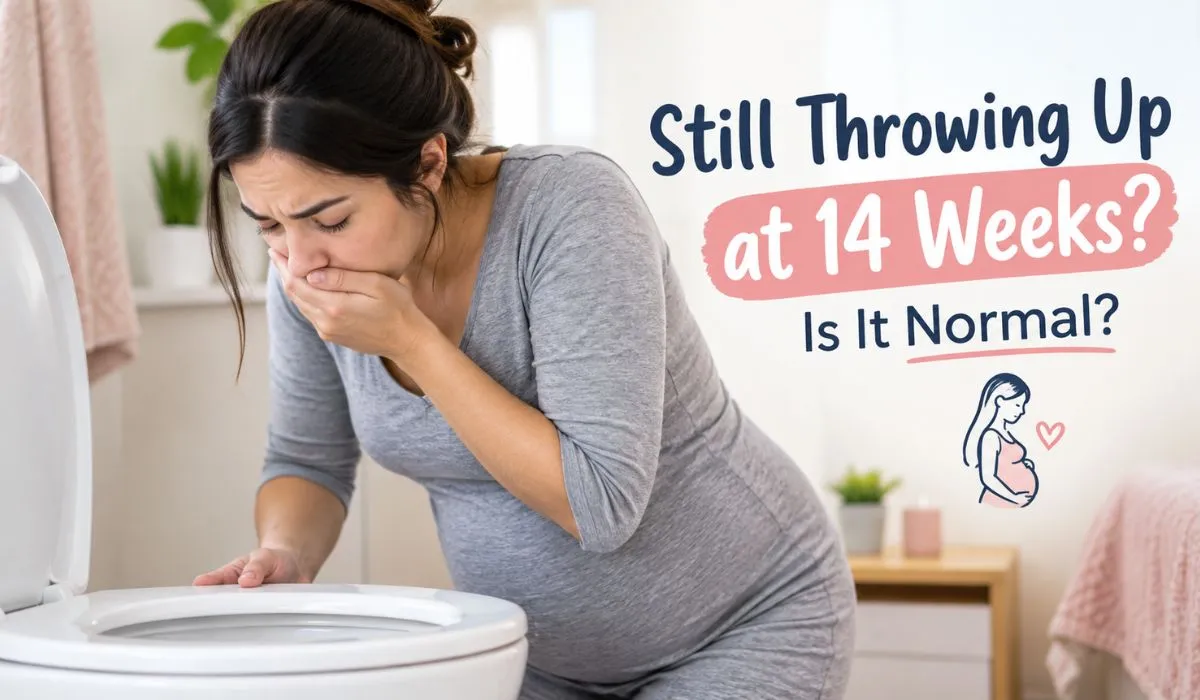
If you’re still throwing up at 14 weeks, you’re probably exhausted and maybe a little worried that something’s off. It’s not. Most women start feeling better between weeks 13 and 14, but a lot of others are right where you are: still nauseous at 14, 15, even 16 weeks, wondering when their body finally got the memo that morning sickness was supposed to be over. Yours just runs on its own timeline, and that’s genuinely okay.
Table of Contents
Why This Is Taking Longer Than You Expected
Morning sickness really comes down to hCG and estrogen. Those hormones spike hard early on, and nausea rides right along with them — but every body burns through that spike at its own pace. Some women feel like themselves again the second they hit week 13. Others are still throwing up at 14 weeks pregnant, typing “16 weeks and still throwing up” into Google at 6am, wondering if this is ever going to end. You’re not doing anything wrong. This is just how it’s going for you this time.
A few things can drag it out. Twins mean more hCG circulating, which takes longer to clear. An empty stomach or dipping blood sugar makes queasiness worse than it needs to be, and dehydration, poor sleep, or a rough week emotionally all pile on top of it. And here’s one people rarely mention — your prenatal vitamin might be part of the problem. The iron in a lot of formulas is genuinely rough on a sensitive stomach, and that alone can keep you feeling sick after your hormones have started to calm down.
Here’s the reassuring part: nausea usually peaks around weeks 9 to 10 for most pregnancies, then eases through weeks 13 and 14. So if you’re still deep in it, you’re much closer to the end than the middle. Most women feel a real, noticeable shift somewhere between weeks 16 and 18. A smaller group carries a bit of nausea further into the second trimester — annoying, sure, but still completely within normal range.
Is This Still “Regular” Morning Sickness?
There’s a real line between ordinary pregnancy nausea and hyperemesis gravidarum, the medical term for excessive vomiting in pregnancy. Regular morning sickness is miserable, but you’re still getting some food and fluids down, even in small bites. Hyperemesis looks different — real weight loss, dehydration, and struggling to keep down even water. According to ACOG, it only affects a small share of pregnancies, but it needs real medical support, sometimes IV fluids or prescription anti-nausea medication. If that sounds closer to what you’re going through, please ask your OB about seeing a hyperemesis specialist. You don’t get a medal for pushing through this alone.
What Actually Helps Right Now
Honestly, small and boring beats dramatic every time. Eat a little every two to three hours instead of waiting for three big meals — an empty stomach makes everything worse. Keep something bland like crackers or plain rice within arm’s reach so you can nibble before you even sit up. Sip water or ginger tea slowly instead of gulping it. And if your prenatal vitamin seems to be a trigger, talk to your provider about taking it with food, moving it to bedtime, or switching to a gentler formula. You shouldn’t have to choose between your nutrition and your sanity.
When to Actually Call Your Doctor
Please reach out if you can’t keep food or water down for more than a day, you’re losing weight, feeling dizzy when you stand, seeing blood in your vomit, or your urine is dark or scarce. Fever, sharp belly pain, or a racing heart also deserve a same-day call. These can point to dehydration or hyperemesis gravidarum, and both respond really well to treatment when you catch them early.
FAQs
Is it normal to still be throwing up at 14 weeks pregnant?
Yes, truly. Many women are still nauseous or vomiting at 14, 15, and even 16 weeks before things settle in the second trimester.
When does pregnancy nausea usually peak?
Around weeks 9 to 10, with real improvement typically starting by weeks 13 to 14.
Can you have hyperemesis gravidarum without constant vomiting?
Yes — severe nausea that keeps you from eating or drinking enough can still count, even without nonstop vomiting.
When will this finally stop?
Most women feel a real shift by weeks 16 to 18, though some carry a bit of nausea a little further into the second trimester.