

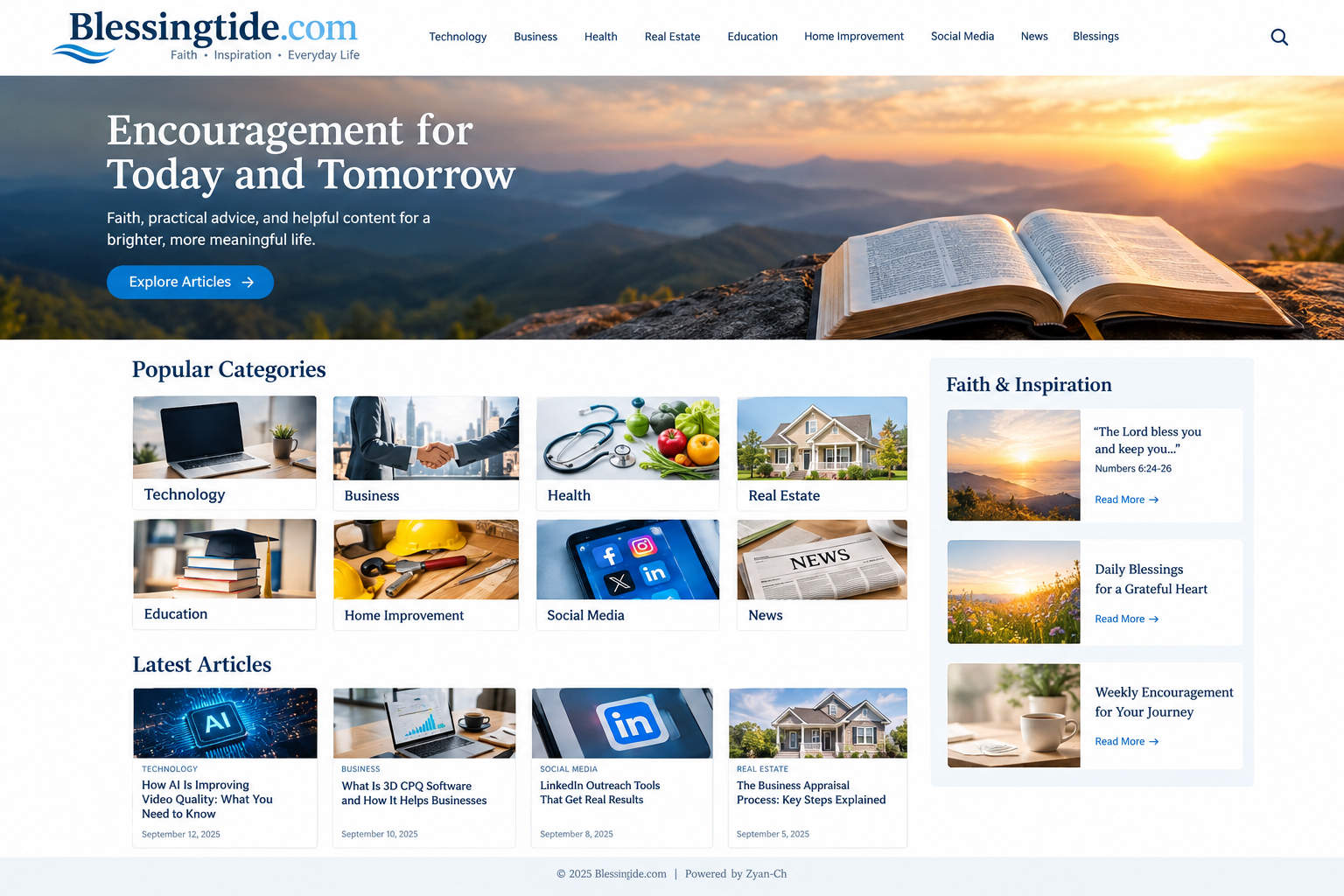
Blessingtide.com started as an inspiration site. The name signals it, the About page confirms it, and the footer still credits the brand to “Zyan-Ch.” The original content was prayers, Bible verses, daily and weekly blessings, and short Christian encouragement pieces — the kind of writing people copy into a text message or a greeting card.
That’s no longer what the homepage shows.
Current categories run across technology, business, health, real estate, education, home improvement, social media, and news. Recent articles have covered AI video quality, 3D CPQ software, LinkedIn outreach tools, and business appraisal processes. Alongside that, the blessing collections are still there and still published.
So the accurate description is: a general-interest publishing site with faith-based roots. Not a ministry. Not a news outlet. Not a niche Christian resource. A broad content site that kept its original name.
This matters for the search itself. Two people can visit the same domain and form completely opposite impressions of it, which is exactly the kind of confusion that generates branded searches.
Why people add “USA” to the query
Four patterns cover most of this traffic:
1. Publisher verification. Someone reads an article — often a celebrity biography or net-worth piece — doesn’t know the site, and appends “usa” out of habit. It’s the same reflex behind “is [brand] usa legit.”
2. Relevance checking. A reader wants to know if a health, legal, or financial article was written for a US audience before acting on it.
3. Navigational searching. People simply looking for the site and adding their country, the way they’d search “netflix usa.”
4. Domain confusion. This one is real and specific — see below.
Notice what none of these mean: that an American edition exists.
blessingtide.com vs. BlessingtideUS.com
This is the part most write-ups on this keyword skip past, and it’s the single most practical thing a searcher can learn.
| blessingtide.com | BlessingtideUS.com | |
|---|---|---|
| Brand name used | BlessingTide | Blessingtide USA |
| Stated origin | Faith, prayer, blessings, gratitude | Independent informational site |
| Current focus | Mixed: blessings plus tech, business, health, real estate, lifestyle | Biographies, public figures, celebrities, careers, relationships, estimated net worth |
| Relationship | Separate domain | Separate domain |
They are not the same publication. The similar names do not indicate shared ownership, shared editorial standards, or shared accuracy.
If a search for “blessingtide.com usa” drops you on BlessingtideUS.com, you are not on the site you searched for. Check the address bar before you cite anything.
Is blessingtide.com based in the United States?
Here’s the honest answer rather than the hedge: nothing on the site establishes a US base, and nothing establishes a foreign one either.
The About page describes a global audience. The Contact page offers an email address and submission channels — general questions, corrections, editorial inquiries, business proposals — but no physical address. There’s no company registration statement, no legal entity name beyond the “Zyan-Ch” brand credit in the footer, and no corporate address in the footer or privacy policy.
Registrar records don’t fill the gap either. Like most small publishing domains, blessingtide.com’s registration details sit behind standard WHOIS privacy protection, which replaces the registrant’s name and address with the proxy service’s. That’s routine — it’s the default on most registrars now and carries no negative implication by itself. It just means the public record won’t answer the ownership question.
What you can say with confidence:
- The site is accessible to readers in the United States.
- Accessibility is not incorporation, headquarters, or ownership.
- There is no regional US edition of blessingtide.com.
What you can’t say: who owns it, where it operates from, or who writes the individual articles when no byline appears.
That gap isn’t proof of anything shady. Plenty of legitimate independent publishers run this way. But it does mean the site can’t be evaluated as an institution — only article by article.
How to vet any single article on the site
Because the editorial range is so wide, treating “is blessingtide.com reliable?” as one question produces a useless answer. A Saturday blessing and a net-worth estimate are not the same kind of claim and don’t need the same scrutiny.
Run these five checks in about thirty seconds:
- Byline. Is a named author listed, and does the name appear elsewhere with relevant background? No byline on a health, legal, or financial piece is a meaningful gap.
- Date. Published or updated when? Technology, pricing, regulations, and public-figure details go stale fast. Evergreen inspirational content doesn’t.
- Sourcing. Do important claims link out? A link should lead to evidence — an official page, a court record, a government site, a primary interview — not to another blog repeating the same sentence.
- Fact vs. estimate. Watch for “estimated,” “reported,” “believed to be.” Net-worth figures in particular are almost always estimates, because private individuals don’t publish their assets, debts, and contracts.
- Jurisdiction. For anything involving law, tax, insurance, healthcare, employment, or pricing — does the article say which country it applies to? US rules also vary by state.
Rough rule: the more a wrong answer would cost you, the stronger your source needs to be. For a shareable morning blessing, none of this matters. For a claim that shapes a medical, legal, or financial decision, a general-interest article shouldn’t be your only source regardless of which site published it.
The bottom line
“Blessingtide.com USA” is a question, not a website. People search it because they’ve encountered an unfamiliar publisher and want to know who’s behind it and whether the content applies to them.
The answers: blessingtide.com is a single global domain with no US edition, faith-based in origin and general-interest in practice, with ownership and location not disclosed on its public pages or in its registration record. Separately, BlessingtideUS.com brands itself “Blessingtide USA” and covers unrelated subject matter — check which domain you’re on.
Use it for inspiration and casual reading. Verify anything consequential somewhere else.
FAQ
Is there a separate Blessingtide.com USA website?
No. There’s no US edition or regional version of blessingtide.com. The phrase is a search variation, not a domain. A different site, BlessingtideUS.com, does call itself “Blessingtide USA,” but it’s a separate publication covering biographies and public figures.
Who owns blessingtide.com?
Not publicly disclosed. The site’s footer credits the brand to “Zyan-Ch,” but no company name, registration, or physical address appears on its public pages, and the domain registration sits behind standard WHOIS privacy protection.
Is blessingtide.com a Christian website?
It has Christian roots — prayers, Bible verses, and blessings are still part of its stated mission — but its current publishing covers technology, business, health, real estate, and other general topics. It’s best described as a general-interest site with faith-based origins.
Can people in the USA read blessingtide.com?
Yes, it’s accessible without restriction. But accessibility doesn’t mean the content was written for a US audience. Anything involving law, tax, healthcare, insurance, or pricing should be checked against a US source.
Is blessingtide.com reliable?
Reliability varies by article, not by domain. Inspirational content needs no verification. Biographical details, net-worth figures, and any health, legal, or financial claim should be confirmed against primary or official sources before you act on it.