

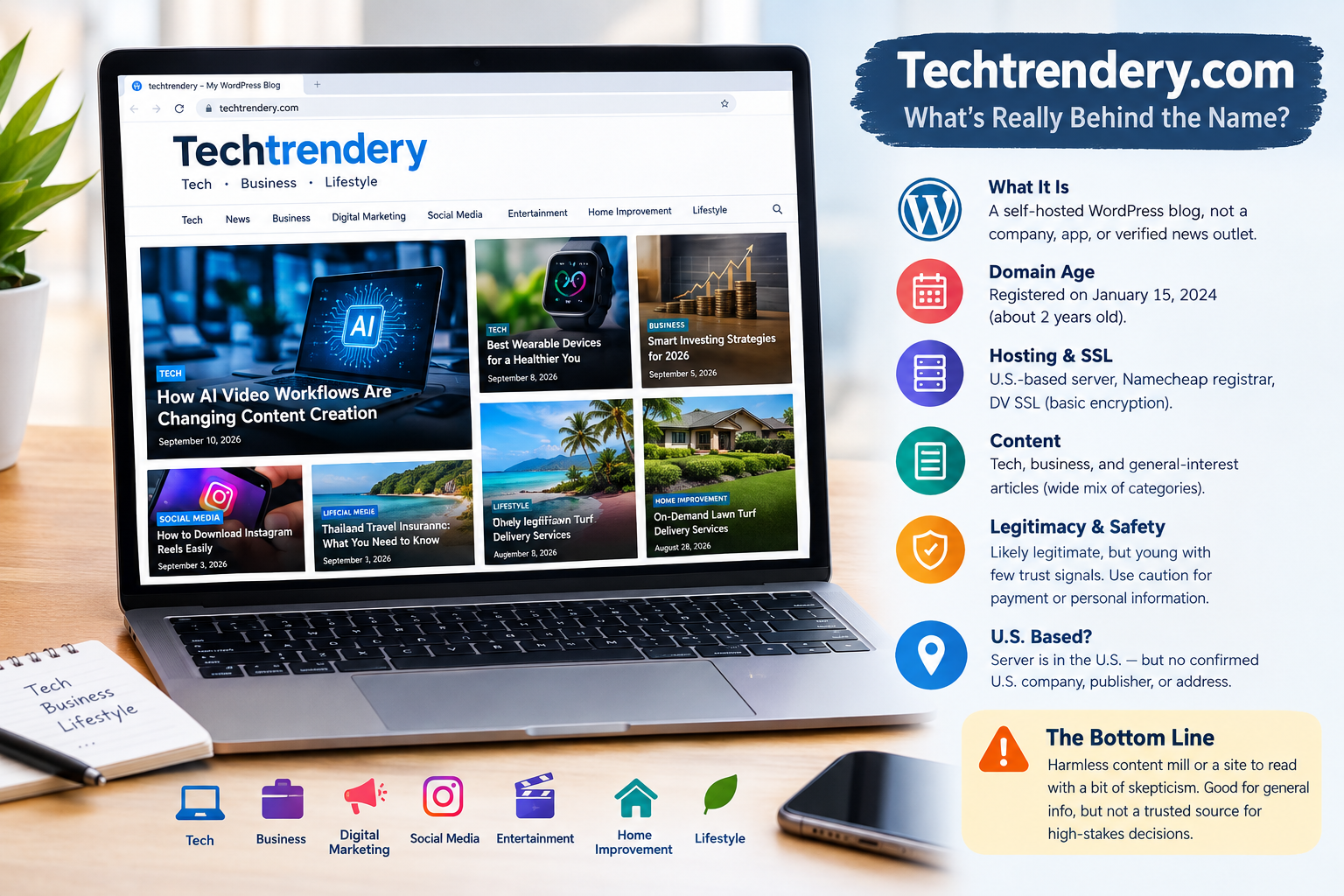
Techtrendery com is a WordPress-based content site that publishes tech, business, and general-interest articles. It’s not a company, an app, or a verified American outlet — it’s a two-year-old blog registered through Namecheap, hosted on a U.S. server, currently running on a default, uncustomized WordPress title (“My WordPress Blog“). If you’re trying to figure out whether it’s worth reading or worth trusting, the honest answer sits somewhere between “harmless content mill” and “handle with a bit of skepticism.”
Here’s what I found when I actually checked, instead of guessing from the name.
Table of Contents
What Techtrendery com Actually Is
Strip away the branding and Techtrendery com is a self-hosted WordPress blog — you can tell because its own homepage title tag still reads “techtrendery – My WordPress Blog,” the default WordPress ever generates when nobody bothers to set a custom site title. That’s a small detail, but it tells you something real: whoever runs this site hasn’t put much effort into the basics of presenting it as a professional publication.
According to public domain records, the site was registered on January 15, 2024 through NameCheap, Inc., putting it at roughly two years old as of this writing. It’s hosted on a U.S.-based server tied to Namecheap’s own hosting infrastructure, and it runs a domain-validated (DV) SSL certificate issued by Sectigo — the cheapest, most basic tier of SSL available, confirming only that the connection is encrypted, not that any organization behind the site has been vetted.
None of that makes it a scam. It just means Techtrendery com is a young, low-overhead, general-content site — not an established newsroom with a known publisher, editorial staff, or verifiable U.S. headquarters, whatever the name implies.
What’s Actually Published There Right Now
Instead of describing the site in the abstract, here’s what’s actually sitting in its categories as of September 2026:
- Tech / Technology — pieces on AI video workflows, wearable devices, app localization, contractor software, and a genuinely detailed explainer on proxy services (specifically INSOCKS-style residential proxies for business use)
- News — a mix of IT infrastructure, fintech compliance, and business-surveillance topics, not breaking news in the traditional sense
- Business — investing, event ROI, and a piece on how companies get discovered by AI answer engines like ChatGPT and Perplexity (generative engine optimization, essentially)
- Digital Marketing — local SEO and backlink guides
- Social Media — Instagram Reel downloaders, anonymous story viewers, TikTok video-saving tools
- Entertainment — animation/motion graphics explainers, streaming guides, and at least one viral-meme profile piece
- Home Improvement and general lifestyle posts, including oddly specific ones like Thailand travel insurance and on-demand lawn turf delivery
That’s a wide spread for one blog. It’s the kind of category list you see on sites built primarily to rank for a large volume of unrelated search terms, rather than sites built around one editorial focus. Neither approach is automatically bad — but it does mean no single article should be assumed to carry deep subject-matter expertise just because it’s published there.
One thing worth flagging directly: while checking the site’s category pages, I found the exact same intro paragraph about accessibility and product design duplicated word-for-word across two different listings on the Social Media archive page. That’s a common fingerprint of templated or spun content production, and it’s a reasonable flag when you’re deciding how much weight to give any specific claim on the site.
Is Techtrendery com Legit or Safe to Visit?
Based on third-party domain-reputation data, the verdict lands as “probably not a scam, but young and thin on trust signals.” A few specifics:
- Domain age: around 2 years — young enough that reputation trackers flag it for extra scrutiny by default
- Traffic rank: low on standard traffic-ranking tools, which is typical for a site this age but also means there’s no large, established reader base vouching for it through behavior data
- Server neighbors: the site’s hosting environment has been flagged for sharing server space with other low-trust websites — not proof of wrongdoing on Techtrendery’s part, but a signal worth knowing
- Registrar: NameCheap is a mainstream registrar used by millions of legitimate sites, but it’s also popular with low-effort or short-lived content sites because registration is cheap and fast
- SSL: present and valid, but domain-validated only — it confirms encryption, not business identity
Put together, that’s not a red-flag profile for malware or phishing. It reads more like a fast, low-budget content operation than a scam operation. Still, if you’re about to enter payment details, sign up for anything, or act on financial, legal, or medical information based on an article there, that’s exactly the situation where the site’s youth and thin verification should make you double-check elsewhere first.
Is Techtrendery com Based in the USA?
Short answer: hosting location and company headquarters are two different things, and only one of them is actually confirmed here.
The server infrastructure is U.S.-based. That’s verifiable. What isn’t verifiable from any public source is a registered company name, a named publisher, an editorial team, or a physical business address behind the site — the kind of information you’d expect from an outlet that’s actually presenting itself as an American publication. The WHOIS registrant information is not publicly displayed, which is standard privacy practice and not unusual, but it also means there’s no way to independently confirm who owns or runs the site.
So “Techtrendery com USA” is best read as a search phrase people type in, not evidence of a distinct American edition or a confirmed U.S. company. The site can be relevant to U.S. readers — plenty of its content is written with an American audience in mind — without being headquartered, incorporated, or staffed in the United States.
How to Actually Use the Site (If You’re Going to)
If you land on an article there while researching something, treat it the way you’d treat any unverified blog post rather than a trade publication:
- Check for a byline and date. Named authors and clear publish dates are a baseline trust signal that not every article on the site consistently provides.
- Cross-check anything specific. Product claims, pricing, technical specs, or “how X works” explanations should be confirmed against the actual company’s documentation or a source with known editorial standards.
- Never enter payment or personal information based solely on an article there. Use it for background reading, not as the final word before a purchase or account signup.
- Skip it for anything high-stakes. Health, legal, tax, or immigration questions need a licensed professional or an official government source — not a general-interest blog, regardless of how confidently an article is written.
Quick FAQ
Is Techtrendery com a real news outlet? No. It’s a general-content WordPress blog covering tech, business, and lifestyle topics, not a staffed newsroom with verified reporters.
Is Techtrendery com dangerous or a scam? Third-party domain checks classify it as likely legitimate, not a scam site — but with several “young, low-trust-signal” flags worth knowing before you act on anything it publishes.
Who owns Techtrendery com? Not publicly disclosed. WHOIS registrant details are private, and the site itself doesn’t list a named publisher, company, or editorial team.
Why does it show up for “USA” searches? Its server is U.S.-hosted and some of its content targets American readers, but that’s different from being a confirmed U.S.-headquartered company.
Should I trust articles from Techtrendery com? Treat them as a starting point, not a final source — especially given the site’s age, lack of visible bylines on some posts, and at least one instance of duplicated boilerplate text found across its own pages.