

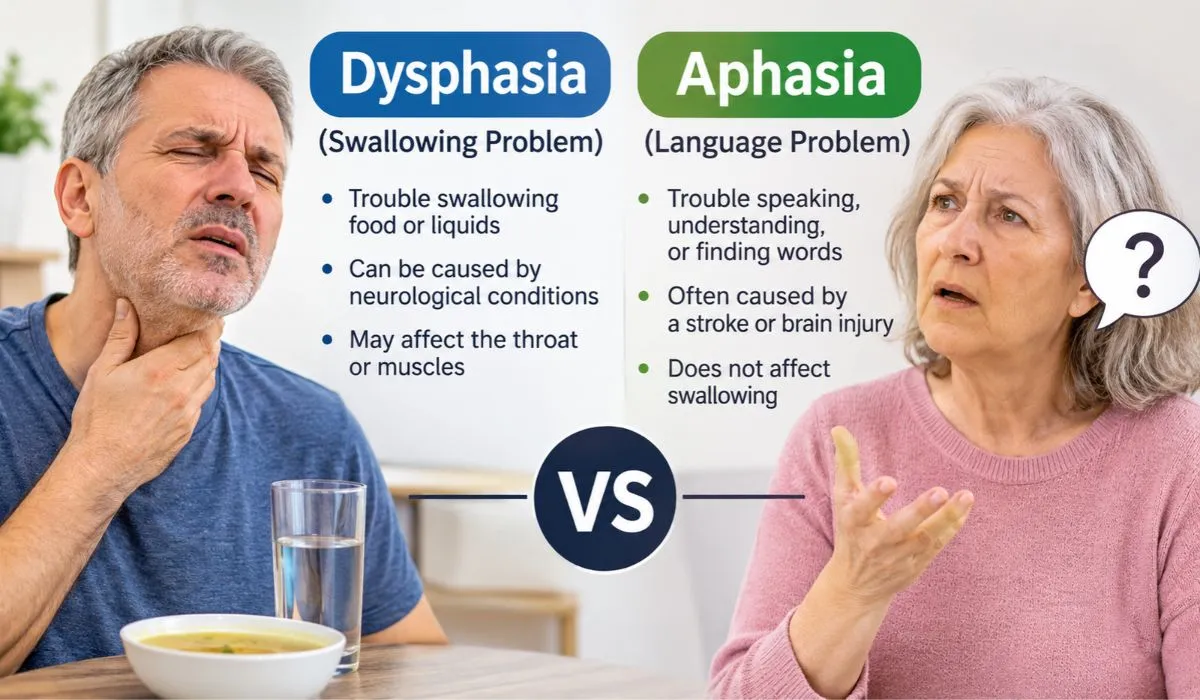
Both mean trouble with language after damage to the brain. Dysphasia is the older word and usually suggests a milder problem, while aphasia is what most doctors in the US call it today, whether it’s mild or severe.
Table of Contents
“Wait, Which One Is It?”
Imagine a friend texts you late at night. Her grandfather just had a stroke, he’s struggling to talk, and one nurse said “dysphasia” while another said “aphasia.” She wants to know if they’re different things. What do you tell her?
You tell her it’s the same family of problem, and she can stop worrying about the labels.
It’s a naming habit more than a medical split. The old idea was that dysphasia meant some speech was left, and aphasia meant most of it was gone. You’ll still hear that in the UK. In the US, the National Institute on Deafness and Other Communication Disorders (NIDCD) and the American Speech-Language-Hearing Association (ASHA) use aphasia across the board.
Oh, and don’t mix it up with dysphagia. That one’s about swallowing.
What It Can Look Like
Language mostly lives on the left side of the brain, so a stroke there is the usual culprit. The NIDCD lists stroke first, then head injuries, tumors, infections and brain diseases that get worse slowly.
How it shows up really depends on the person. Some know what they want to say but get it out in tiny, slow pieces. Some talk nonstop but swap words around, saying “shoe” when they mean “spoon” and never noticing. Some can’t follow a simple question. And it’s tough, for them and for everyone watching.
But the thinking part is usually fine. That surprises a lot of families. Grandpa isn’t “gone,” the words are just hard to reach.
For Moms-to-Be and New Moms
Stroke around pregnancy is uncommon. It still happens, during pregnancy and in the weeks after delivery. ACOG says sudden slurred speech, a drooping face or one weak arm should be treated as an emergency, so please don’t put it down to being tired. The CDC adds that fast treatment can save more brain tissue. Call right away.
Getting Better
A lot of people do, though how much and how quickly varies. The first few months usually bring the biggest jumps, yet people can keep improving for years if they practice. A speech-language pathologist designs the practice, which might include picture cards, repeating words, gestures, even phone apps.
At home? Slow your talking down. Keep sentences short. Count to five before you rescue them with the word, and I know that’s hard. Switch off the radio. Don’t baby-talk. They hear you fine, most of the time.
Quick Answers
Is dysphasia the same as aphasia?
Basically yes. Aphasia is the modern term.
Is dysphasia the same as dysphagia?
No. Dysphagia means trouble swallowing.
Does it go away by itself?
Sometimes it improves fast, especially after a small stroke. Therapy usually helps most.
Does it make someone less smart?
No. Thinking tends to stay intact.
Who treats it?
A speech-language pathologist, often with a neurologist.