
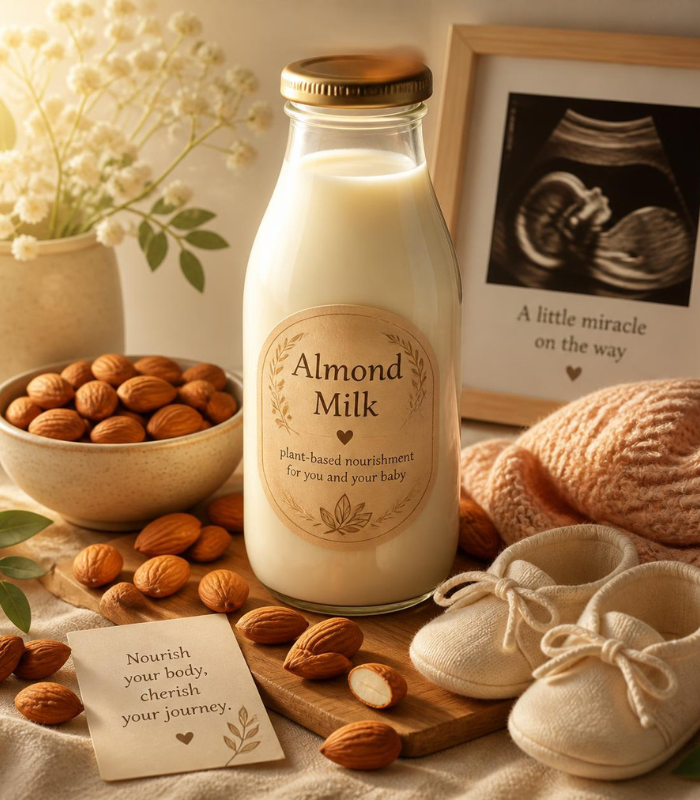
I’ll admit this one is personal. In my second trimester, I switched to almond milk because I’d read somewhere it was “cleaner” — whatever that meant — and I felt genuinely proud of myself every morning pouring it into my coffee. It wasn’t until a routine bloodwork check flagged slightly low vitamin D that my midwife asked what I was drinking, looked at the carton I’d brought in out of curiosity, and pointed at the nutrition label. Unsweetened, yes. Fortified? No. I’d grabbed the wrong one for months without realizing there was a “right” one.
That’s the whole story in miniature, honestly. Almond milk is safe in pregnancy, and it can genuinely help you — but only if it’s the fortified version, and even then, it’s not a complete substitute for dairy. Let me walk you through what I wish someone had told me before that appointment.
Table of Contents
The word that actually matters (and the one I skipped over)
Almonds themselves don’t naturally carry much calcium or vitamin D. Whatever shows up on the nutrition label was added during manufacturing. My “clean” unfortified carton was basically flavored almond water — pleasant, but nutritionally not doing much of the heavy lifting I assumed it was.
Fortified almond milk is a completely different product on paper, even though it tastes almost identical. It can genuinely help you toward pregnancy’s calcium target (commonly cited around 1,000 mg/day) and support your vitamin D intake. The lesson I took from my own carton-reading mistake: flip it over every single time, because “fortified” and “unfortified” versions from the same brand often sit right next to each other on the shelf.
What it still won’t give you, even the good version
Here’s the part that still catches people off guard. Even fortified almond milk has almost no protein — often 1 gram per cup or less, compared to roughly 8 grams in dairy milk. If it’s become your main “milk,” that’s a real gap, not a minor one. I had to consciously add more eggs and Greek yogurt back into my mornings once I understood this, because I’d unintentionally been treating my smoothie milk like it was contributing more than it was — my full breakfast during pregnancy guide covers exactly how I rebuilt that meal afterward.
It’s also generally not a source of iodine, which your baby’s brain and nervous system development need more of during pregnancy — another nutrient that’s easy to quietly under-consume if dairy has dropped out of your routine.
What it does bring to the table
I’m not telling you to abandon it — I still drink it, just more intentionally now:
- Lower in calories and saturated fat than whole dairy milk
- Naturally lactose-free, genuinely useful if dairy upsets your stomach
- A real source of vitamin E from the almonds themselves
- No cholesterol
What I actually check now before buying
- Pasteurized — non-negotiable, always
- Fortified with calcium and vitamin D — check the nutrition panel itself, not the marketing on the front
- Unsweetened — sweetened versions add sugar you don’t need, especially relevant if you’re watching blood sugar
- Carrageenan — some brands add it as a thickener, and it bothered my stomach more than plain versions did
A reasonable amount lands around 1–2 cups a day, alongside — not instead of — other protein and calcium sources. For actual recipes built around that balance, my pregnant breakfast ideas post has a handful that use almond milk the smart way.
Almond milk vs. soy milk vs. cow’s milk
| Protein | Calcium | Best for | |
|---|---|---|---|
| Cow’s milk (pasteurized) | High (~8g/cup) | Naturally high | Overall completeness |
| Fortified almond milk | Very low | High (fortified) | Lower-calorie, lactose-free option |
| Fortified soy milk | High (~7-8g/cup) | High (fortified) | Closest match to dairy if avoiding it entirely |
If I’d been avoiding dairy completely rather than just supplementing it, soy milk would have been the smarter primary choice — it actually matches dairy’s protein, which almond milk simply doesn’t try to do. Either way, it’s worth cross-checking your day against our protein-rich foods for pregnant women list to make sure the gap is actually covered.
The one thing worth mentioning to your provider
If you have any history of tree nut allergy, even mild, it’s an easy thing to forget applies to almond milk specifically. Bring it up before making it a daily habit.
What I’d tell you to do right now: go check the actual carton in your fridge. Look at the calcium number (you want it fortified, ideally 300+ mg per cup) and the protein number (expect it to be low, and plan accordingly). It takes thirty seconds and it would have saved me a slightly awkward moment at a prenatal appointment.
 Alona Smith