

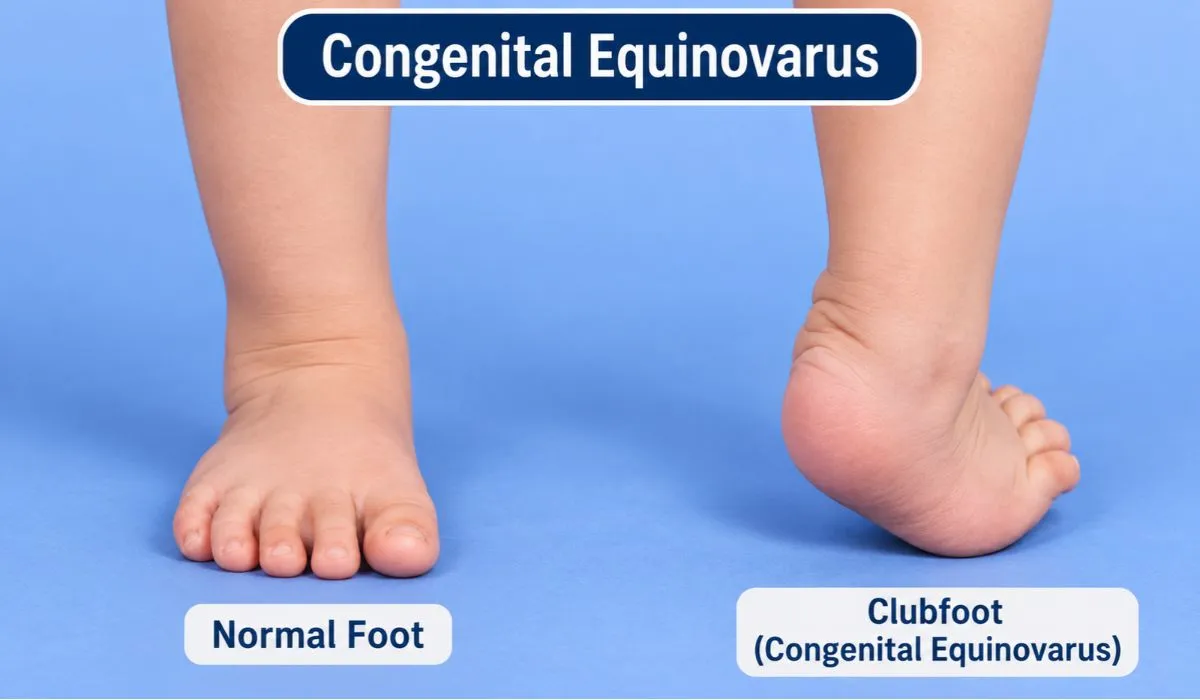
Congenital equinovarus is the medical name for clubfoot. A baby is born with one foot, or both, turned inward and pointing down. It sounds scary, but it’s very treatable, and most kids who get early care grow up walking, running and kicking a ball like everyone else.
Table of Contents
Say a friend texts you at midnight: “They saw something on the baby’s foot at the scan. What does that even mean??” That’s how it usually starts. A quiet moment during the ultrasound, a long word nobody explained, then hours of Googling. So let’s slow down and go through it like we’re sitting at your kitchen table.
So what is congenital equinovarus, really?
The full name is congenital talipes equinovarus, and “congenital” just means present from birth. The foot looks twisted because the tendons on the inside and back of the lower leg are shorter and tighter than they should be. They tug the foot into that curled shape. It doesn’t hurt the baby. It can happen in one foot or both, and it’s about twice as common in boys. The CDC says roughly 1 in 1,000 babies in the US is born with it, so you’re far from alone.
Why does it happen? Often nobody can say. Family history seems to play a part. Smoking in pregnancy and low amniotic fluid have both been linked to it. Once in a while it comes along with something like spina bifida, which is one reason doctors keep going on about prenatal care and folic acid early in pregnancy. But for most families there’s no clear cause, and I really want you to hear this: you didn’t cause it. Not the coffee, not the stress, not that one flight.
How it gets found
Usually at the mid-pregnancy scan, somewhere around 18 to 20 weeks. ACOG lists that anatomy scan as a routine part of prenatal care. Sometimes it isn’t spotted until the baby is born. If it’s caught early, you might get sent to a pediatric orthopedic specialist before delivery, and honestly that’s a gift. You can ask every silly question you have without a newborn in your arms.
What treatment actually looks like
The main approach is called the Ponseti method, and it’s gentle. No big surgery. It starts in the first week or two after birth. Once a week the doctor moves the little foot a bit closer to where it should sit, then wraps it in a fresh cast. That goes on for about five to eight weeks.
Most babies also need one small snip to the Achilles tendon. It’s done in the clinic with numbing and takes a few minutes. Then comes a last cast for around three weeks.
After that it’s the brace, and this is the hard part. Two shoes joined by a bar, worn nearly around the clock for about three months, then at night and naps until somewhere near age four. Babies hate it the first week or two. Parents do too. Still, skipping the brace is the number one reason clubfoot comes back. Research summarized by the NIH puts the success rate at about 90 percent or higher when families stick with it.
A few things that help. Go to every single cast appointment, even the awkward-timing ones. Keep the cast dry, so sponge baths for a while. Check the toes now and then, and if they look swollen, cold or oddly colored, call the clinic right away. Ask the nurse to show you the brace twice, then practice at home. And find a clubfoot parent group, because other parents will tell you things the doctor never thinks to.
One mistake worth naming: waiting to see if it sorts itself out. It won’t, and starting early makes everything easier.
FAQs
Is congenital equinovarus the same as clubfoot?
Yes. Clubfoot is just the everyday name for it.
Will my baby walk late?
Usually not. Babies treated early tend to hit walking milestones on time.
Can clubfoot be prevented?
Not completely. Skipping cigarettes, taking prenatal vitamins and keeping up with checkups all help a pregnancy go well, though.
Does casting hurt?
It’s uncomfortable for a few minutes. Most babies calm down fast with a feed or a cuddle.
Will my next baby have it too?
The odds go up a little if a close relative has it, but most families never see it twice. A genetic counselor can give you your own numbers.
 buzztumt@gmail.com