

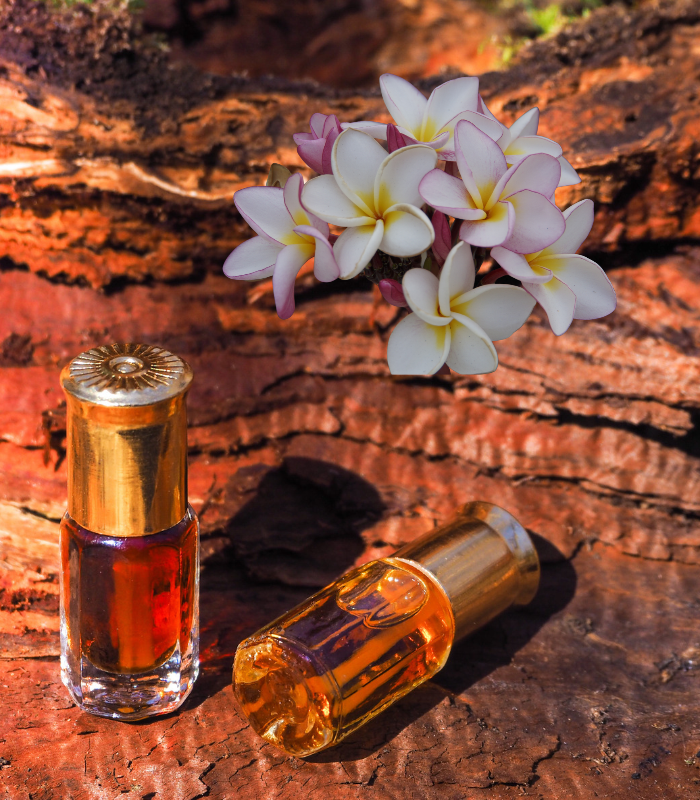
Nag champa is an Indian incense scent made from sandalwood, a fragrant champa flower, and traditionally a sticky tree resin called halmaddi. It smells sweet, floral, creamy, and earthy. It became famous in the West in the 1960s and 70s, and today the name covers hundreds of products, from hand-rolled temple-style sticks to cheap perfume-dipped ones.
What does “nag champa” mean?
The “champa” part is the easy half. It refers to champa or champak flowers, which are sacred and prized for perfume across South Asia.
The “nag” half is less certain. The most common explanation is that nag is the Sanskrit and Hindi word for snake, linked to the naga serpent deities of Hindu and Buddhist tradition. A second explanation exists too. One of the trees called champa in India, Mesua ferrea, also goes by the names nagkeshar and nagchampa, so “nag champa” may simply name that flower.
You will also see a tale that snakes are drawn to champa trees by the scent. That is folklore, and we found no source for it. Treat it as a nice story, not a fact.
Which champa flower is really used?
There is no single “champa”. Several different Indian flowers carry the name, and this is the biggest source of confusion online.
| Plant | Common name | Role in nag champa |
|---|---|---|
| Magnolia champaca (formerly Michelia champaca) | Champak, yellow champa, swarna champa | The flower most often used for classic nag champa scent |
| Plumeria rubra | Frangipani | Often used for scents called simply “champa”, and sometimes in products sold as nag champa |
| Mesua ferrea | Nagkeshar, nagchampa | Occasionally used; possible source of the “nag” in the name |
So when one website says nag champa is made from plumeria and another says magnolia, both are describing something real. Makers use different flowers, and many use none at all, relying on a blended fragrance instead.
The champak flower is related to magnolia, which is why people describe its scent as peachy, honeyed, and a little like orange blossom and tea, with a faint spice.
Halmaddi: the mystery ingredient
Halmaddi is the part of the story most articles skip.
What it is. Halmaddi is the resin that seeps from cuts in the bark of Ailanthus triphysa (also known as Ailanthus malabarica), a tall evergreen tree of the Indian subcontinent and Southeast Asia. In India both the tree and its resin go by the name halmaddi. It is a thick, molasses-like liquid when fresh and hardens into a brittle, balsamic-smelling resin as it ages. Some incense makers blend it with honey to keep it pliable.
What it does. It gives hand-rolled sticks their sticky, workable paste and a soft, slightly musky, resinous warmth. Many sellers also describe it as moisture-absorbing, which is why traditional sticks can feel faintly damp or stay flexible.
Why it is hard to find now. Crude harvesting methods killed trees, and by the 1990s India’s forest authorities had banned resin extraction, according to published botanical references. That pushed prices up and led many makers to reduce halmaddi or replace it with other resins. This is why you should be skeptical of any label that promises “real halmaddi” without saying where it came from.
One small correction. Some pages call this tree the “tree of heaven”. There is a related tree with that common name (Ailanthus altissima), but it is a different species. The Indian tree is sometimes called the Malabar tree of heaven.
Sandalwood: the base note
Sandalwood supplies the creamy, smooth foundation that holds the floral notes together. In a traditional masala stick it is ground into the powder blend. Real sandalwood is expensive and increasingly scarce, so cheaper sticks often use sandalwood oil substitutes or a sandalwood-style fragrance. If a stick is very cheap, assume the sandalwood is not the real thing.
Other ingredients you may find
Nag champa has no fixed recipe. Depending on the maker, you may see:
- Other resins such as benzoin, amber, cedar, or pine
- Spices like cardamom or black pepper
- Oils such as ylang-ylang, rose, orange blossom, or vanilla
- A natural binder powder (often made from tree bark)
- Charcoal powder, in some sticks
- A bamboo core for stick incense
Masala vs dipped: how it is made
There are two broad methods, and the difference matters for how the incense smells.
Masala (hand-rolled). Fragrant powders and resins are mixed into a dough and rolled around a bamboo stick. The scent comes from the ingredients themselves. This is the traditional style.
Dipped. A plain, nearly scentless stick is soaked in perfume or fragrance oil and dried. The scent comes from the liquid, not from a ground-ingredient paste.
Neither is automatically “bad”, but they are different products. Masala sticks tend to smell richer and burn softer. Dipped sticks can smell sharper and more perfume-like. Seller claims that dipped incense always makes black smoke or headaches are marketing, not science.
A short history of nag champa
Champa flowers in Indian culture. Champa blossoms have long been used as offerings and as natural perfume for hair and skin in India. Incense is deeply woven into Hindu and Buddhist practice, so it is no surprise that champa-scented blends grew out of temple and household traditions.
Nag champa as a commercial fragrance. Reference sources describe nag champa as a commercial fragrance of Indian origin, used in incense, soap, perfume oil, candles, and other scented goods. The exact moment of its invention is not documented. Claims that it was created by monks, or that every temple holds its own secret recipe, are common but hard to verify.
The 1960s and the Satya story. The brand most people connect with nag champa, Satya, comes from Shrinivas Sugandhalaya, an Indian incense company reported to have been founded in 1964 in Mumbai and later associated with Bangalore. Over time the company’s blue-and-white box became the image many Westerners hold in their heads when they hear “nag champa”.
You may read that the scent was created on the day the founder’s son was born, and that “nag” comes from his name. That story circulates among retailers, but we could not find a primary source for it. It also seems to blur the history of the Satya brand with the history of the scent, which existed in other forms. Until a company source confirms it, treat it as unverified.
Reaching the West. Nag champa spread beyond India as travelers, spiritual seekers, and importers carried it home in the 1960s and 70s, and it became tied to yoga studios, meditation spaces, record shops, and counterculture life. Today it is among the best-known incense scents in the world.
Brand vs scent. This is the point most guides get wrong. “Nag champa” is a scent family. Satya is one famous brand of it. Many other Indian makers sell their own versions, each with a different balance of sweetness, spice, and wood.
What does nag champa smell like?
Expect a warm, sweet, floral scent with a creamy wood base. Reviewers often pick out honey, resin, light spice, and powdery notes. It is rich and a little heavy, which is why people either love it or find it overwhelming.
How to spot a better-quality stick
No simple test is perfect, but these clues help:
- Read the ingredient list. Look for named botanicals and resins rather than just “fragrance” or “natural extracts”.
- Smell it unlit. A masala stick usually has a noticeable scent before burning.
- Look for “masala” or “hand-rolled”. These point to the traditional method, though they are not a guarantee of quality.
- Be wary of the price. Real sandalwood and resins cost money.
- Buy from sellers who name the maker and origin.
Does nag champa have health benefits?
Nag champa is traditionally used to set a calm mood for meditation, yoga, and rest. Many people find a consistent scent a helpful cue for winding down, and that experience is real for them.
But claims that it lowers cortisol, cures insomnia, kills germs in the air, or acts as an aphrodisiac are not backed by good evidence for nag champa specifically. Treat those as tradition or marketing, not medical fact.
Safety: what the research says about the smoke
This is the section most competitors leave out. Burning anything indoors releases particles and gases.
- Lab and home studies have found that burning incense raises indoor fine particle levels, and in poorly ventilated rooms those levels can exceed international air quality guidelines.
- One study found that ventilating while burning cut estimated inhalation health risk by roughly two thirds compared with burning in a sealed room.
- Another study found large differences between incense sticks in benzene released, from barely above background levels to very high concentrations.
- Research in Indian temples has recorded particle levels above national standards where lots of incense is burned.
Practical steps:
- Burn one stick at a time, in a room with a window or door open.
- Do not burn incense in a small, closed room, a car, or a bedroom while you sleep.
- Take extra care around children, older adults, and anyone with asthma, COPD, or other breathing conditions. If you are pregnant or have a lung condition, ask your doctor whether incense is a good idea for you.
- Birds, cats, and other small pets can be sensitive to smoke and fragrance. Keep them out of the room and ask your vet if unsure.
- Keep burning sticks away from fabric, paper, children, and pets, and use a proper holder to catch ash.
Sticks, cones, and other forms
Stick incense is the classic format. Cones are shaped pastes without a bamboo core and tend to burn faster with denser smoke. Backflow cones and resin forms exist too. Nag champa is also sold as soap, perfume oil, candles, and wax melts, but the fragrance in those products is usually a blend or synthetic, not the traditional masala mix.
Frequently asked questions
What is nag champa incense made of?
Traditionally, sandalwood, champa flower, and halmaddi resin, mixed into a paste and rolled on bamboo. Many modern versions use other resins, oils, or fragrance.
Where does nag champa come from?
India. The exact origin of the scent is not documented, though it is closely tied to Indian incense traditions and, in its famous modern form, to Satya.
Is nag champa the same as Satya?
No. Nag champa is a scent style. Satya is one well-known brand that makes it.
Does nag champa contain sandalwood?
Traditionally yes, though cheaper versions may use substitutes.
Does nag champa contain drugs?
No. It is a fragrance incense. It is not a psychoactive product.
What does the name nag champa mean?
“Champa” refers to the champa flower. “Nag” is most often explained as “snake”, though one champa species is also known as nagkeshar, which offers another explanation.
Is nag champa smoke safe to breathe?
Like all incense smoke, it adds particles to indoor air. Use ventilation, burn it sparingly, and be cautious with children, pets, pregnancy, and breathing conditions.
Is halmaddi still used?
In small amounts at best. Resin extraction from the tree was banned in India by the 1990s, so many makers have reduced it or replaced it.
The takeaway
Nag champa is both older than its brands and newer than its myths. At its best it is a hand-rolled blend of sandalwood, champa flower, and halmaddi resin. In practice, the name covers a wide range of recipes. Read labels, ventilate your room, and enjoy it for what it is: a warm, floral scent with deep roots in Indian incense tradition.
 Alona Smith