

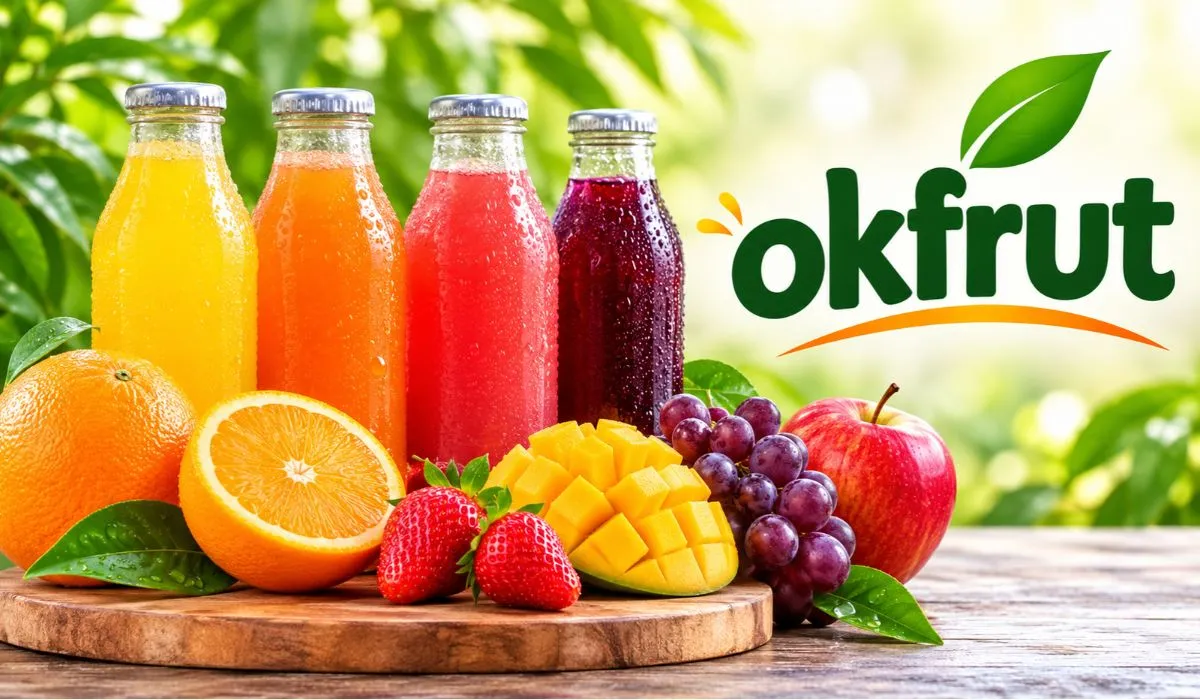
If you’ve ever spotted a brightly colored bottle called Okfrut at a Hispanic grocery store and wondered what it was, you’re not alone. Search the name online and you’ll get some very strange answers. So let’s clear it up.
Table of Contents
Okfrut (also written Ok Frut or OKFRUT) is a brand of bottled fruit drinks. They come in Latin American flavors like mango, guava, hibiscus, and grapefruit. You’ll mostly find them in Hispanic supermarkets and the Latin aisles of bigger chains across the US. It isn’t a superfruit, a supplement, or an app. It’s a drink.
What Is Okfrut, Really?
Think of Okfrut as the grab-and-go cousin of agua fresca, the sweet fruit waters poured from big glass jars at taquerias and paleterias in Mexico. Okfrut gives you that same idea in a shelf-stable bottle.
A few things about the brand can actually be checked. The name “OKFRUT” was filed as a US trademark on September 16, 2014, and covers fruit-flavored beverages. Public trademark records link the mark to a company called Whole Fruit JPC. The registration itself came through in March 2017, and the filing lists October 2016 as the first use in commerce.
The brand also says on its Facebook page that it has made fruit-based drinks for over 65 years. That’s the company’s own claim, and no independent history backs it up. Likewise, an exact original launch date hasn’t been publicly confirmed, and a trademark filing date isn’t necessarily the day the first bottle was sold. So the honest summary is that the US brand is roughly a decade old, even if the recipes may go back further.
Why Do So Many Websites Get Okfrut Wrong?
This is where it gets a little funny. One website calls Okfrut a tropical superfruit from Southeast Asian rainforests. Another says it’s a productivity app. A third describes a free movie-streaming site, and some claim it’s a health supplement or a fruit-delivery service.
None of that holds up. Short, unusual names attract content farms that write about any keyword with search traffic and then make up the details. The giveaway is that these pages never point to a label, a trademark record, or a store listing. The real product, on the other hand, shows up in packaged-food databases and grocery listings with barcodes and ingredient lists you can check for yourself.
A good rule of thumb: if a page about this drink brings up “clinical studies” or “mitochondrial support,” close the tab.
Okfrut Flavors: What’s on the Shelf?
The lineup leans on classic Mexican and Central American fruit-water flavors. Based on public food databases, store listings, and the brand’s own materials, you’ll find melon (cantaloupe), toronja (grapefruit), piña (pineapple), jamaica (hibiscus), mango, manzana (apple), guayaba (guava nectar, made with 16% juice), and guanábana (soursop).
If you’re picking a first bottle, jamaica is a good place to start. Hibiscus is tart and floral, and it tends to win over people who find melon drinks too sweet. And if you’ve never tried soursop, guanábana is a fun one, since the fresh fruit is hard to find in most US stores.
There’s also a newer wrinkle. Some US retail listings show a strawberry sparkling water under the Okfrut name, sold in six-packs of small cans with zero sugar and zero calories. That’s quite different from the older bottled fruit drinks, and it may not be stocked everywhere.
What’s Actually in the Bottle?
Less fruit than the name suggests. That’s normal for this category, but it helps to know before you treat it like juice. Different flavors also have quite different labels, so no single description fits them all.
Sugar and calories
Here’s what USDA branded food data and older labels show. The melon flavor in a 20 fl oz bottle has about 112 calories and 25 g of sugar. Grapefruit comes in at around 118 to 120 calories and 26 g of sugar, depending on bottle size. An older cantaloupe label showed 20 g of sugar in a 473 mL bottle.
For context, the American Heart Association suggests women keep added sugar to about 25 g a day, and men to about 36 g. That means a single melon bottle can use up a woman’s whole daily allowance.
The melon flavor uses cane sugar alongside the artificial sweeteners sucralose and acesulfame potassium. That’s how it stays near 112 calories for 20 ounces. Hibiscus is the outlier. An older label reported zero calories and no added sugar, using those same low-calorie sweeteners instead. The guava nectar is the most juice-forward of the bunch, with a short ingredient list: water, guava purée, sugar, citric acid, natural flavor, vitamin C, and natural color.
Dyes, sweeteners, and the BVO question
Most of the fruit-water flavors rely on synthetic dyes. The grapefruit label lists Yellow 5, Yellow 6, and Blue 1. Pineapple uses Yellow 5, Yellow 6, and caramel color, and melon lists Yellow 6 and Red 40. The guava nectar is the exception, using natural color.
Here’s the detail most guides skip. The grapefruit ingredient list in public databases, last updated in April 2020, includes brominated vegetable oil (BVO), an additive once used to keep citrus flavor from floating to the top of a drink. The FDA revoked approval for BVO in July 2024, and manufacturers had until August 2, 2025 to remove it. The UK banned it back in 1997.
So bottles made today shouldn’t contain it. But many online labels are years old, so don’t rely on them. Check the ingredient list on the bottle in your hand.
Okfrut vs. Soda vs. Homemade Agua Fresca
Okfrut sits in the middle. A 20 oz Coca-Cola has about 240 calories and 65 g of sugar, while a 20 oz Okfrut melon has about 112 calories and 25 g. That cuts the sugar by more than half. Compared with homemade agua fresca, though, you’re trading fresh fruit and control over sweetness for convenience, dyes, and preservatives.
Honestly, if you have a blender, homemade wins. Blend 2 cups of cantaloupe with 3 cups of cold water, strain it, then stir in a tablespoon of sugar and a squeeze of lime. It takes about 10 minutes, and it tastes a lot closer to what you’d get at a market stall in Mexico City.
It’s also worth remembering that a fruit drink isn’t the same as fruit juice. A label that says 100% juice is a different product from one with water, a small amount of juice, added sugar, and flavoring. If you want to know how much real fruit you’re getting, look for the declared juice percentage rather than the pictures on the bottle. And while a drink may contain puree, it’s still no replacement for eating whole fruit, which brings fiber along with it.
Where to Buy It and What It Costs
Look in Hispanic supermarkets, the Latin aisles of big chains, and delivery apps. Recent online listings show about $1.49 for a 20 fl oz bottle at Ideal Market (via Instacart) and $1.79 for a 16 oz guanábana at H-E-B (via Instacart). That’s cheaper than most single-serve juices and about the same as a bottled soda.
Selection depends a lot on where you live. Texas, California, and other places with large Mexican American communities tend to have the widest range. Regular availability in the UK or other countries hasn’t been confirmed, and a retailer’s product page doesn’t guarantee the item is in stock, so check the seller, the expiration date, and the full ingredient label before ordering.
Who Should Drink It, and Who Should Skip It?
Okfrut is a good fit if you want a cheap, nostalgic, lower-sugar alternative to soda with real Latin American flavors. It’s also handy for parties, since the bottles taste close enough to the real thing to serve with tacos.
You might want to skip it, or at least read the label closely, in a few cases. If you’re avoiding artificial sweeteners, note that some flavors use sucralose and acesulfame potassium. If you’re avoiding synthetic dyes, most of the fruit-water flavors contain them. And if you’re managing blood sugar, around 25 g per bottle adds up fast. For everyday hydration, plain water is still the simplest choice.
What to Check Before You Buy
Start with the description: is it fruit juice, a fruit drink, flavored water, or sparkling water? Then read the nutrition facts and serving size, since a big bottle can hold more sugar than you’d guess. If you want to avoid dyes, preservatives, or certain sweeteners, scan the ingredients too. Most importantly, trust the label on the bottle you’re holding over one you found online, because formulas change.
Frequently Asked Questions
Is Okfrut a fruit or a drink?
It’s a drink brand. It sells bottled fruit drinks, nectars, and some sparkling waters in flavors like melon, hibiscus, guava, and grapefruit. Pages calling it an exotic superfruit don’t cite any real source.
Who owns Okfrut?
US trademark records connect the OKFRUT mark with Whole Fruit JPC. Commercial and distribution arrangements can change over time.
Is it the same as agua fresca?
It’s inspired by agua fresca, but it isn’t the homemade kind. Traditional agua fresca is fresh fruit blended with water and a little sugar. These bottles add preservatives and, in most flavors, synthetic dyes so they last on a store shelf.
How much sugar is in one bottle?
About 25 to 26 g for the 20 oz melon and 16 oz grapefruit flavors, based on USDA data. That’s less than half of the 65 g in a 20 oz Coke, but it still equals the American Heart Association’s suggested daily added-sugar limit for women. Some varieties, like hibiscus and the sparkling water, were listed with no sugar.
Does it still contain BVO?
It shouldn’t. An older grapefruit label listed BVO, but the FDA banned the additive, with a compliance deadline of August 2, 2025. Check the bottle to be sure.
Is it caffeine-free?
Yes. None of the published ingredient lists include caffeine, coffee, tea, or guarana. That makes it a reasonable soda swap for kids, though the sugar still counts.
Is Okfrut an app, a website, or a delivery service?
No. The available trademark and product records identify it as a beverage brand, and nothing verified supports the other claims.
Final Thoughts
Strip away the made-up superfruit stories and what’s left is simple: an inexpensive bottled fruit drink with familiar Latin American flavors and a lot less sugar than regular soda. Just keep in mind that the flavors vary, and so do the sweeteners, dyes, and sugar. The most useful habit is to read the label on the bottle in your hand, because old ingredient lists go stale, as the 2025 BVO deadline shows.