

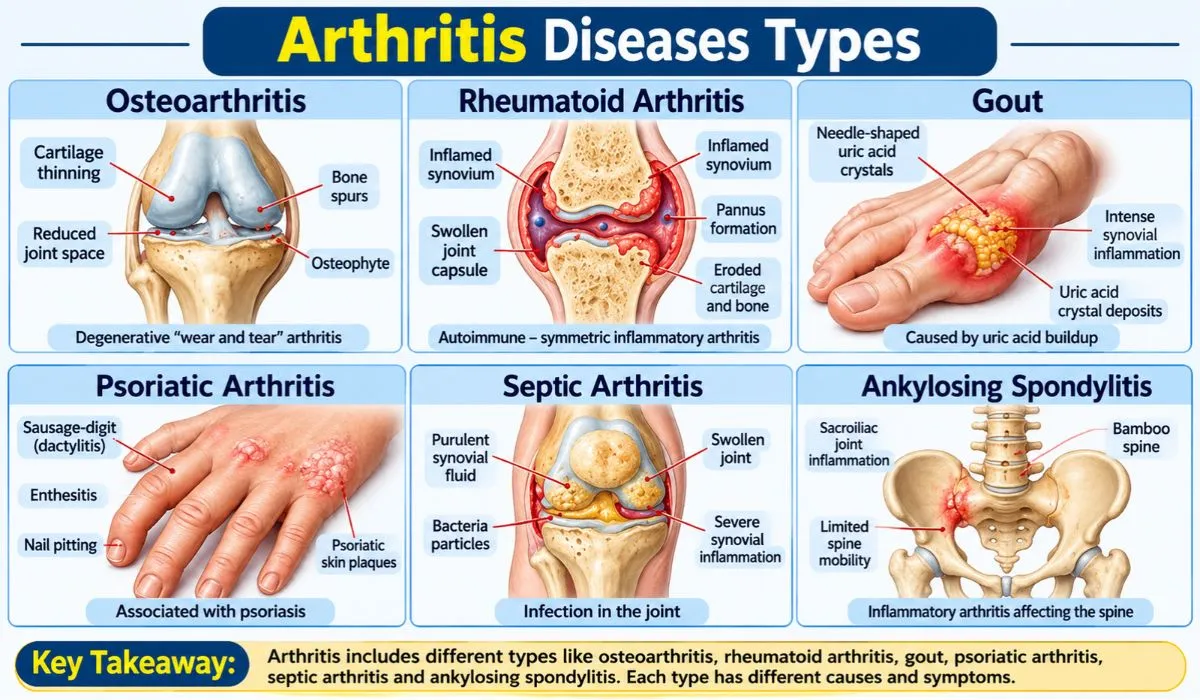
Arthritis means inflamed, achy joints, and there are more than 100 kinds. The big four are osteoarthritis, rheumatoid arthritis, psoriatic arthritis and gout. The CDC puts it at about one in four US adults, which is a lot of sore knees.
Table of Contents
Say your sister calls and tells you her hands hurt every morning. You’d probably say “oh, it’s arthritis,” and you’d be half right. Which arthritis is the real question. I’ll go through them the way I’d explain it over tea.
Start with osteoarthritis, since it’s the one almost everybody has heard of. Cartilage, the slippery cushion between your bones, wears down over time. Knees, hips, hands, lower back. It aches more after you’ve been on your feet all day and eases when you sit. Stiffness in the morning is normal, but it usually clears up in half an hour or so. Old injuries make it likelier, and so does carrying extra weight, because your knees feel every pound.
Rheumatoid arthritis, or RA, plays by different rules. It’s an autoimmune disease, so the immune system gets confused and attacks the lining of your own joints. Both sides tend to go together, like both wrists. The stiffness can last an hour or longer, and a lot of people say the exhaustion is worse than the pain. That surprises them. RA is more common in women, and for a site like this one that matters, because many women find their symptoms ease during pregnancy and then roar back after delivery. Some RA medicines, methotrexate being the best known, aren’t safe in pregnancy. If you’re planning a baby, have that talk with your doctor early. Think of this as general information, not medical advice.
Then there’s psoriatic arthritis. Some people with psoriasis, the scaly skin patches, end up with joint trouble too. A giveaway is a finger or toe that swells up like a sausage. Nails with little pits are another clue.
Gout is the loud one. Uric acid forms crystals in a joint and the pain shows up out of nowhere, often at night, often in the big toe. People joke that even the bedsheet hurts, and honestly it’s not much of a joke.
A few more are worth knowing. Ankylosing spondylitis goes after the spine, usually starting in the lower back of younger adults. Juvenile idiopathic arthritis is what kids can get. Lupus can bring joint pain. And septic arthritis is a joint infection, so if a joint is hot, swollen and you have a fever, don’t wait. Go get seen.
What about food? It won’t fix arthritis, no. But it can help you feel better. Health experts often suggest fish for omega-3s, lots of vegetables, and keeping your weight in a healthy range. If you’re pregnant or trying, regular prenatal nutrition still counts, including folic acid benefits and DHA for pregnancy. Ask your doctor before you start any pregnancy supplements, since some interact with arthritis drugs.
When do you actually need a doctor? If joint pain hangs around more than a couple of weeks, if swelling keeps coming back, or if you’re stiff for more than an hour most mornings. With RA, catching it early can save your joints in the long run. The NIH and the Arthritis Foundation both say so.
Questions People Ask
What’s the most common type of arthritis?
Osteoarthritis.
Is all arthritis autoimmune?
No. RA, psoriatic arthritis and lupus arthritis are. Osteoarthritis and gout aren’t.
Can you get arthritis young?
Yes. RA, psoriatic arthritis and ankylosing spondylitis often begin in your 20s and 30s.
Does pregnancy make arthritis worse?
Depends on the person. Many women with RA feel better while pregnant, then flare after the baby arrives.