

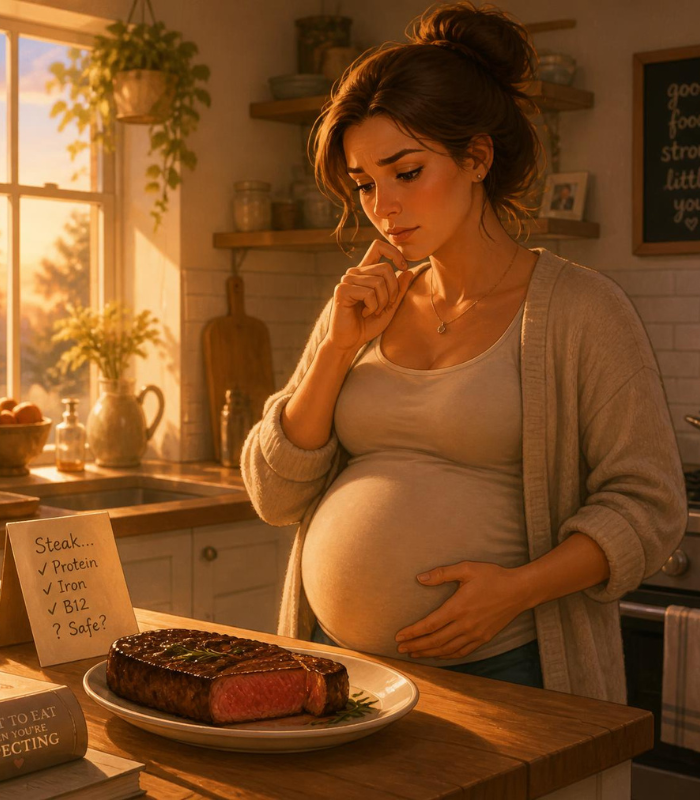
No — skip the medium-rare and ask for it medium or medium-well instead. Steak itself was never the problem here; it’s really just about temperature. As one OB-GYN puts it, “I never tell my patients to give up steak, I just tell them to give up the pink in the middle.” That’s basically the entire rule, condensed into one sentence.
A lot of pregnant women get told to cut out steak completely, which isn’t really accurate and honestly takes away one of the better sources of iron and protein available to you right now. The real rule is a lot narrower than “no steak” — it’s just “cook it hotter than you normally would.” The USDA and the American College of Obstetricians and Gynecologists both put the safe threshold for whole cuts of beef at 145°F, followed by a 3-minute rest afterward. Medium-rare usually tops out somewhere around 130 to 135°F. That gap of ten or fifteen degrees is exactly where the risk is hiding.
Table of Contents
Why a Nice Sear Doesn’t Actually Save You
Searing does a good job of browning the outside and killing off bacteria sitting right on the surface — but that’s really all it accomplishes. It does nothing for anything living deeper inside the muscle, which is precisely where that pink, medium-rare center stays under-temperature the whole time. This is what trips a lot of people up, because a beautifully seared steak just looks done. It isn’t necessarily, no matter how good the crust looks.
What’s Actually at Stake Here
Pregnancy naturally dials back parts of your immune system so your body doesn’t end up attacking the fetus, and that same shift also makes you more vulnerable to a couple of specific things that can hide out in undercooked beef.
Toxoplasma gondii is a parasite that’s capable of crossing the placenta, and in rare cases it can cause serious neurological or eye damage in a developing baby. Listeria monocytogenes is the other big concern — pregnant women contract it at a meaningfully higher rate than everyone else, and it’s been linked to miscarriage, stillbirth, or a severe infection in a newborn. On top of that, undercooked beef can also carry E. coli and Salmonella, both of which are simply worse news to deal with during pregnancy than they’d be otherwise.
What “Safe” Actually Looks Like, By Cut
Whole cuts of beef, pork, lamb, or veal — steaks, roasts, chops — need to hit 145°F and then rest for three minutes, which lands you right around medium. Ground meat is a different story entirely, since grinding mixes any surface bacteria all the way through the meat, so there’s no such thing as a “safe undercooked center” the way there technically could be with a whole cut. That means burgers, meatballs, and meatloaf all need to reach 160°F with no pink anywhere. Poultry sits even higher, at 165°F, also with no pink remaining.
How to Actually Pull This Off Without Overthinking It
The easiest fix is picking up a cheap instant-read thermometer — they run about $12, and they take all the guesswork out of it, since color is a genuinely unreliable way to judge doneness but temperature isn’t. Just insert it into the thickest part of the steak and trust the number.
At restaurants, it’s worth ordering medium-well rather than medium, since kitchens routinely undercook a “medium” request by a few degrees without meaning to, and asking for medium-well builds in a little extra margin. If something comes out pink or red in the middle, send it back — that’s a completely normal, unremarkable thing to ask for while you’re pregnant, and no server is going to think twice about it. Steak tartare and carpaccio are really the only things that are off the table entirely, since there’s no cooking method involved at all, which means there’s no safe temperature to hit. And once your steak comes off the heat, let it rest for three minutes — the temperature actually holds steady or climbs slightly during that window, which matters for genuinely neutralizing that parasite risk.
The good news is that steak cooked to medium or medium-well, rested properly, still comes out tender as long as you don’t push the heat much past that point. The difference between medium-rare and medium on your actual plate is a lot smaller than it sounds on paper.
Bottom Line
Keep a meat thermometer in your kitchen drawer for the next several months, order medium-well when you’re eating out, and don’t feel the least bit awkward about sending back a pink steak. That’s really the whole strategy.
 Alona Smith