

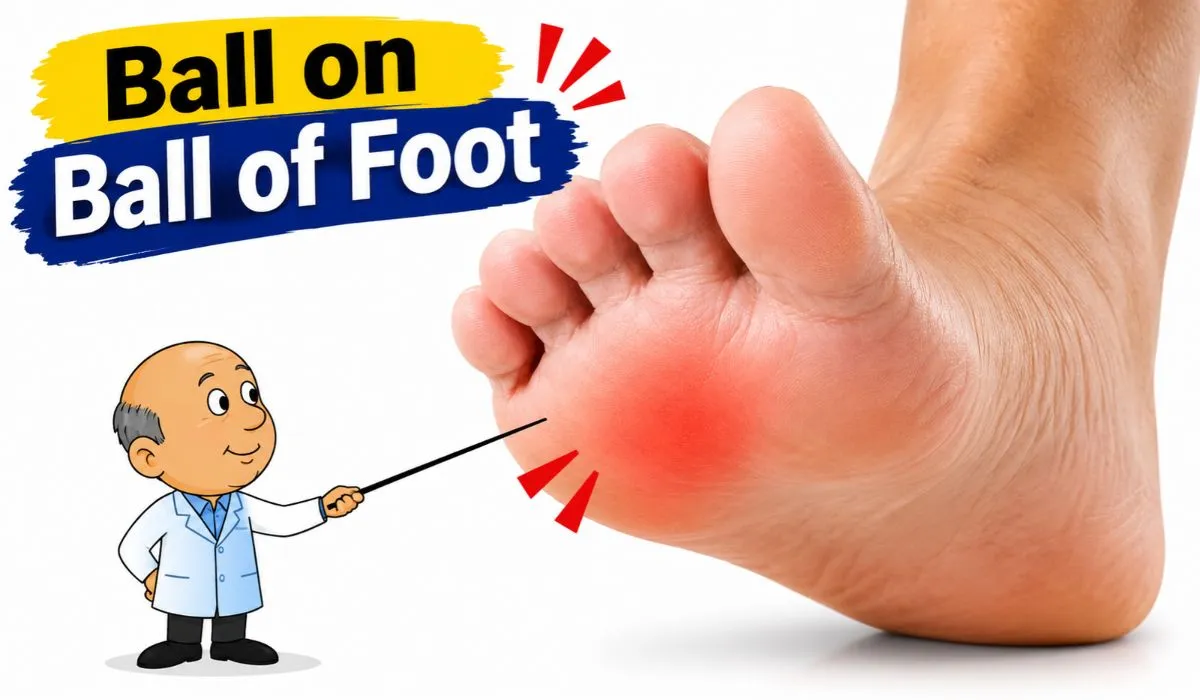
You slip off your shoe at the end of a long day, press your thumb into the front of your foot, and there it is: a tender spot, maybe a hard lump, right on the pad behind your toes. If you’ve noticed a ball on ball of foot, you’re definitely not alone, and the good news is that most of the time there’s a clear explanation and a clear way to feel better.
Table of Contents
Let’s walk through what’s usually going on, what it feels like, and when it’s time to let a podiatrist take a look.
What does a ball on ball of foot actually mean?
When people describe a ball on ball of foot, they’re usually talking about one of two things: pain or a bump sitting right behind the toes, in the cushioned area we call the ball of the foot. Sometimes it’s an ache without anything you can see. Other times there’s a thickened, callused patch, and occasionally a firm lump you can feel beneath the skin.
The ball of the foot carries a surprising amount of your body weight every time you push off to walk, run, or jump. So when something is slightly off with your alignment, your shoes, or your activity level, this is one of the first places to complain.
The most common culprit: metatarsalgia
If your ball of foot is painful or inflamed, the most likely explanation is a condition called metatarsalgia. It’s especially common in people who are physically active, because repeated impact on the front of the foot, from running and jumping for example, can irritate the area over time.
Metatarsalgia tends to announce itself in a few recognizable ways. You might feel a sharp pain or a dull ache just behind the toes. The discomfort usually gets worse when you walk, run, or jump, and eases when you rest. Some people also notice numbness or pain in the toes themselves, and many find it feels worse when they’re walking barefoot on a hard floor.
Rarely is there just one cause. More often it’s a combination of things stacking up: foot alignment that’s a little off, the way you walk, a naturally unusual foot shape, hammertoes, bunions, intense training, extra body weight, or shoes that are simply too tight. Morton’s neuroma and stress fractures can also show up as pain in the same spot, which is one reason persistent pain deserves a proper evaluation.
Why a lump forms on the ball of the foot
Here’s something that surprises many people: a bump on the ball of the foot is often about pressure, not about something growing out of nowhere. The long bones behind your toes are called the metatarsals. When they’re out of alignment, one or more of them can sit lower than the rest, so it becomes more prominent on the bottom of your foot.
When that happens, your weight no longer spreads evenly across the ball of the foot. A few spots end up absorbing far more pressure than they should, and your skin responds the way skin always does: by thickening into a callus. That’s the hard, sometimes painful patch many people notice first.
Beyond calluses, there are a few other skin lesions that love to appear on the bottom of the foot, including plantar warts, porokeratoses, and inclusion cysts. They can look similar at a glance, which is another good reason to have a stubborn spot checked rather than guessing.
When the lump is somewhere nearby
Sometimes the thing you’re feeling isn’t in the ball of the foot at all, even though it seems that way. A painful, callused lump at the bottom of the big toe, for instance, often comes from limited movement in the big toe joint. If the toe can’t bend upward as your heel lifts, extra force lands on the underside of the toe, and the area can enlarge and become tender.
Further back, firm nodules in the arch are called plantar fibromas. These are non-cancerous growths that form in the plantar fascia, the ligament running along the arch. They can slowly enlarge and cause pain when you walk, and while the cause isn’t always clear, treatment usually starts with padding and supportive orthotics. If you find a lump in your arch rather than the ball, mention it to a podiatrist, because the best approach is different.
What you can do at home
The encouraging news is that foot pain in this area can often settle down with a day or two of rest, some ice, and over-the-counter pain medication. Easing off the activity that triggered it gives the irritated tissue a chance to calm down.
After that, it’s mostly about taking pressure off the ball of the foot. Roomier, better-cushioned shoes make a big difference, especially if your current pair squeezes your toes. Many people find relief from metatarsal pads, which sit just behind the ball of the foot and help redistribute pressure, along with supportive insoles or arch supports. Gradually ramping up training instead of jumping into intense workouts also helps keep the problem from coming back.
A note for people with diabetes
If you have diabetes, it’s worth being a little more careful. Areas of high pressure on the bottom of the foot, including the ball and the base of the big toe, can break down over time and form ulcers, and they can become infected. Check your feet regularly, and don’t wait on a callus or lump that seems to be changing.
When to see a podiatrist
Occasional soreness after a long day on your feet is one thing. But if your pain is severe, keeps coming back, or isn’t improving after a few days of rest, it’s time to get it looked at. A podiatrist can figure out exactly what’s behind your ball on ball of foot, whether that’s a pressure callus, metatarsalgia, or something else, and can recommend options like custom orthotics, footwear changes, padding, or, in more stubborn cases, procedures aimed at the underlying cause.
That last part matters. Simply trimming or removing a lump rarely fixes things for good if the underlying alignment or pressure problem is still there. Treating the cause is what keeps the pain from returning.