
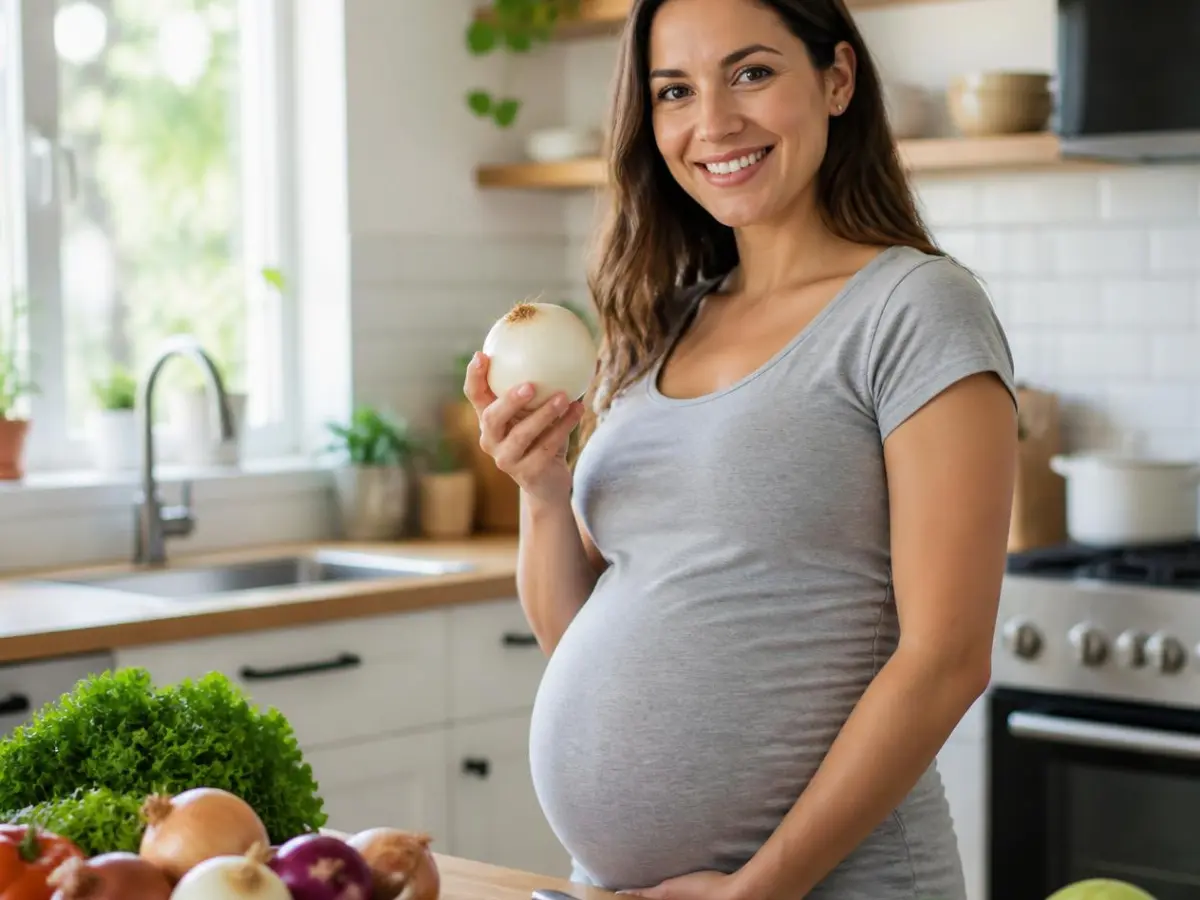
Yes, go ahead. Onions — raw or cooked — are perfectly safe throughout pregnancy. There’s no research linking them to miscarriage, early labor, or anything happening with the baby, despite what you might have heard from a well-meaning aunt or a random forum post at 2am.
If onions do give you trouble during pregnancy, it’s almost never about safety. It’s heartburn. And that’s a completely different problem with a much easier fix.
Table of Contents
What you’re actually getting from an onion
It’s easy to think of onions as “just a flavor thing,” but they’re pulling more nutritional weight than people give them credit for.
| Nutrient (per medium onion, ~110g raw) | Amount | Why it matters right now |
|---|---|---|
| Calories | ~44 | Adds flavor without much energy cost |
| Vitamin C | ~8 mg | Supports immunity and helps your body absorb iron from other foods |
| Fiber | ~1.9 g | Helps with digestion, which slows way down in pregnancy |
| Folate | Small amount | Contributes to neural tube development |
| Vitamin B6 | Present | Involved in metabolism, sometimes helpful for nausea |
| Quercetin | High, especially in the outer layers | An antioxidant compound linked to anti-inflammatory effects |
A few real reasons to keep them around
They’re quietly good for digestion. Between hormones and a growing uterus pressing on everything, digestion tends to slow to a crawl during pregnancy. Onions bring fiber and prebiotic compounds that feed your gut bacteria, which can help keep things moving.
They carry a genuinely interesting antioxidant. Onions are one of the richest food sources of quercetin, a flavonoid that’s been studied for its anti-inflammatory effects. Chronic inflammation has been tied to complications like preeclampsia, so foods with anti-inflammatory properties are generally seen as a plus — though it’s worth being honest that quercetin hasn’t been studied specifically in pregnant people, so think of this as a “reasonable bonus,” not a guarantee.
They let you flavor food without leaning on salt. At around 44 calories an onion, they do a lot of work for very little nutritional cost — useful if you’re also trying to keep sodium in check.
They give your immune system a small boost. The vitamin C content contributes to normal immune function, which matters more than usual since pregnancy shifts how your immune system behaves.
So why do onions bother some people?
If you’ve noticed burning in your chest after a plate of fajitas or a burger loaded with raw onion, that’s your answer, and it’s incredibly common. Pregnancy hormones relax the valve between your stomach and esophagus — the same reason spicy food and citrus start causing problems for people who never had heartburn before. Onions, especially raw ones, are a well-documented trigger. In one clinical study on people prone to heartburn, adding raw onion to a meal actually increased how many reflux episodes they had and how long acid lingered in the esophagus.
The fix isn’t cutting onions out completely — it’s changing how you eat them:
- Cook them instead of eating them raw. Sautéing, roasting, or caramelizing mellows out the compounds that trigger reflux and makes them easier to digest.
- Switch varieties. Red onions and shallots tend to be gentler than yellow or white onions if you’re sensitive.
- Go smaller, not zero. A spoonful of cooked onion in a sauce is a very different experience than a raw slice piled on a sandwich.
The food-safety part that’s actually worth your attention
Onions aren’t a special-risk food, but like any raw produce, they can carry bacteria on their skin — and pregnancy is one of those times your immune system appreciates a little extra caution.
A few habits cover almost all of it:
- Wash whole onions under running water before you cut them, even if you’re planning to peel — bacteria on the outside can transfer inward once your knife goes through.
- If you’re ever unsure about freshness, cooking onions thoroughly takes care of it.
- Skip pre-cut onions that have been sitting out. Once an onion is cut, it’s more prone to bacterial growth, so refrigerate leftovers quickly and use them within a few days.
- It’s worth a quick check for active food recalls before buying — onions have occasionally been linked to multi-state outbreaks. Not something to lose sleep over, just a habit worth having.
Quick answers to what people usually ask next
Can onions cause miscarriage or trigger early labor?
No. This is one of those myths that gets repeated so often it starts to sound true, but there’s nothing in the research to back it up. Onions are considered a completely normal part of a pregnancy diet.
Is raw onion actually worse than cooked?
Not from a safety angle — both are fine as long as they’re washed. Raw onion is just more likely to set off heartburn or an upset stomach if you’re already prone to it, since cooking neutralizes a lot of what causes that reaction.
What about pickled onions?
Also fine, as long as they’re commercially made or properly stored and within date. Just know they’re acidic and salty, which can work against you if heartburn or sodium is already a concern.
Is there a “safe amount” of onion per day?
Not really — there’s no hard limit. The more useful guide is your own comfort: eat what agrees with you, and if a big raw serving leaves you regretting it an hour later, that’s your body telling you to dial it back, not a pregnancy rule you’re breaking.
 Alona Smith