

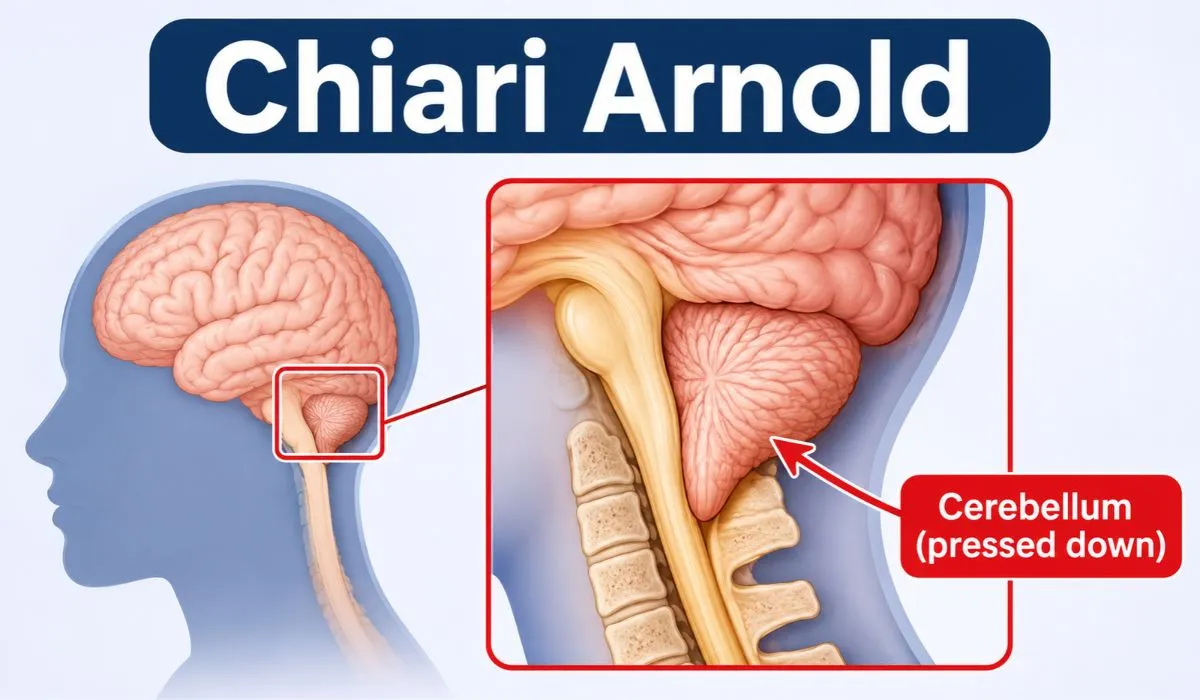
Chiari Arnold, or Arnold-Chiari malformation, is when the bottom of your brain sits lower than it should and presses into the top of the spinal canal. The usual reason is a skull that’s a little too small at the back. Lots of people have it and don’t know.
Table of Contents
I first heard about Chiari Arnold from a friend whose dad kept getting these awful headaches right at the back of his head. Only when he coughed or laughed too hard, never otherwise. He blamed his pillow for about a year. Then a doctor sent him for an MRI, and there it was.
Why Chiari Arnold is so easy to miss
The symptoms are all over the place. Some people feel nothing at all. Some get headaches that flare with a sneeze or a strain. Neck pain, dizziness, tingling in the hands, feeling a bit off balance, fingers that suddenly can’t manage buttons. Others have blurry vision, a ringing in the ears, trouble swallowing, bad sleep, or a low mood they can’t explain.
None of that points at the brain on its own, which is exactly why it takes people years. Doctors tend to look at one thing at a time, and the headache gets treated as a headache.
The types, without the textbook voice
Type I is the common one. Only the lowest bit of the cerebellum slips down, and many people don’t notice until they’re teens or adults. It’s also the only kind you can develop later on.
Type II is different. It usually comes along with a kind of spina bifida called myelomeningocele, and it’s often found before birth. Type III is rare and serious. Type IV is rarer still, and it means the cerebellum didn’t fully form.
If you’re pregnant, or planning to be
Types II and III are often caught on a prenatal ultrasound, because the scan can show signs of spina bifida. The CDC says spina bifida is a neural tube defect, and that taking folic acid before and early in pregnancy helps lower the risk. Health experts suggest 400 micrograms daily for anyone who could get pregnant. It won’t stop every case, but it’s cheap and easy, so worth doing.
And if you already know you have Chiari Arnold? Don’t panic. Many women with Type I have healthy pregnancies. Just tell your neurologist and your obstetrician early, so they can plan for labor and pain relief together.
How it’s found and treated
The test is an MRI. It shows how far the cerebellum has dropped and whether fluid has collected around the spinal cord.
After that, the plan depends on how you actually feel. If you’ve got no symptoms, doctors often just watch and recheck now and then. Painkillers help with headaches. If symptoms get worse, or there’s damage to the nerves, a surgeon may suggest posterior fossa decompression. They take away a small piece of bone at the back of the skull so the brain has more space. It doesn’t change the shape of your skull, but it often eases the pressure.
A few honest tips
If a headache gets worse every time you cough, say so at your appointment. Don’t skip follow-ups just because today’s a good day. If someone recommends surgery, ask for a second opinion. That’s normal, and good doctors expect it. A small notebook where you write down symptoms and dates is surprisingly useful.
FAQs
Is Chiari Arnold dangerous?
Mild cases often aren’t. Severe ones can affect balance, swallowing and breathing, so they need proper medical care.
Can Chiari Arnold be cured?
Surgery can relieve pressure and symptoms, but follow-up checks usually continue.
Can you live a normal life with it?
Many people with Type I do, with or without treatment.
Can folic acid prevent Chiari Arnold?
It helps prevent neural tube defects like spina bifida, which are linked to Type II. It can’t stop every case.
Does it run in families?
Usually not in an obvious way, though some families do see it more than once.