
So you’re hoping for a little boy, and someone told you the right diet might tip the odds in your favor. It’s a tempting idea, and honestly, a very old one — but let’s be upfront about it: no diet can guarantee your baby’s sex. That’s decided by chromosomes, not by what’s on your plate. Still, there’s a popular theory behind the “boy diet” trend, and it’s worth understanding what it actually claims before you rearrange your grocery list.
Table of Contents
How a Baby’s Sex Is Really Determined
Here’s the biology in plain terms. Every egg carries an X chromosome. Sperm carry either an X or a Y. If a Y-carrying sperm reaches the egg first, you get a boy (XY). If it’s an X-carrying sperm, you get a girl (XX). That’s it — that’s the whole mechanism, and it comes down to chance at the moment of conception. Nothing you eat changes your partner’s sperm chromosomes.
That said, some researchers have wondered whether the body’s internal environment — things like vaginal pH or mineral balance — might make it slightly easier for one type of sperm to survive the journey. That idea is really where all the “boy diet” talk originally came from.
Where the “Boy Diet” Idea Comes From
Back in the 1960s, a doctor named Landrum Shettles put forward a theory that’s still floating around fertility forums today. He suggested that Y-sperm (the boy-producing kind) swim faster but don’t last as long, while X-sperm are slower but hardier. His idea was that a more alkaline environment might give the faster, more fragile Y-sperm a better shot at reaching the egg before they fade.
It’s a neat theory, and it’s understandable why it caught on. But it’s worth knowing that major medical bodies like ACOG have never confirmed the Shettles Method actually works. It sits in that space between old wives’ tale and folk science — something couples try because it feels like doing something, not something with solid clinical backing behind it.
What the “Boy Diet” Actually Looks Like
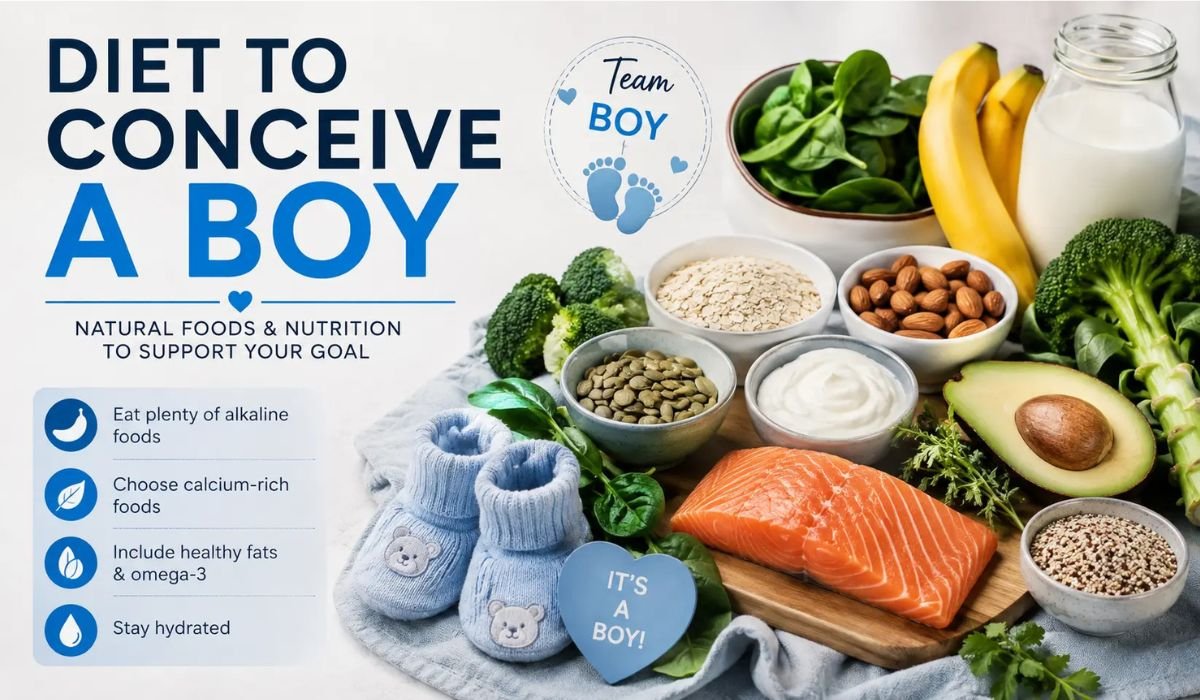
If you go looking, you’ll find the same handful of foods coming up again and again, all loosely tied to that alkaline-diet idea: bananas, red meat, salty snacks, cherries and grapes, leafy greens, whole grains, and even a bit of coffee. The thinking is that potassium and sodium-rich foods push the body toward a more alkaline state, while calcium is thought to do the opposite and favor girls instead. That’s why some versions of this diet also suggest cutting back on dairy.
Here’s the thing, though — calcium isn’t optional. Your bones need it, and so does your baby, whatever the outcome. Dropping dairy entirely to chase a theory isn’t a trade worth making.
What Actually Deserves Your Attention
If you’re preparing your body for pregnancy, your energy is better spent on nutrition that we know matters, regardless of whether you end up with a boy or a girl. The CDC and WHO are pretty consistent on this: get enough folic acid (400–800 mcg a day, since it helps prevent neural tube defects), keep your iron levels up, bring in some DHA and omega-3s for brain development, eat a good mix of whole grains, fruits, vegetables, and lean protein, and try to stay within a healthy weight range going in. None of that changes based on sex-selection theories — it’s just good preconception care.
If You Do Want to Try the Shettles Approach
A few honest tips, if you’re set on giving it a go: track your ovulation closely, since timing is really the centerpiece of this theory, not the food. Don’t cut out entire food groups without talking to your doctor first. Go in with realistic expectations — most of the research on this shows little to no real shift in outcomes. And whatever you decide about the diet, keep taking your prenatal vitamin. That part isn’t optional.
A Few Things to Watch Out For
The biggest trap here is treating any diet as a guarantee — it isn’t, and no study has shown one to be. Cutting calcium or dairy completely can leave you short on something your body genuinely needs. And it’s easy to get so focused on “boy foods” that you lose sight of overall preconception nutrition, which matters far more for a healthy pregnancy than any theory about chromosomes and pH levels. Loading up on sodium long-term isn’t great for your blood pressure either, so keep that in check.
FAQs
Can diet really determine my baby’s sex?
No. That comes down to whether an X or Y sperm fertilizes the egg — diet doesn’t touch that.
Is the Shettles Method scientifically proven?
Not really. It’s a popular theory, but no major medical organization has confirmed it works.
What foods are linked to the “boy diet” theory?
Bananas, red meat, salty snacks, cherries, and leafy greens tend to top the list, based on the alkaline-diet idea.
Is it safe to eat a lot of salt to try for a boy?
Not as a long-term habit — too much sodium isn’t heart-healthy. Talk to your doctor before making any big dietary changes.
What should I actually focus on before conceiving?
A balanced diet with enough folic acid, iron, DHA, and a healthy weight — that matters far more than the sex you’re hoping for.