
A healthy first trimester diet isn’t about eating more — it’s about getting a few specific things right while a lot of huge stuff is happening quietly in the background. Mainly: folate, iron, and a little DHA. Your calorie needs barely shift in these first twelve weeks. What’s actually going on is that your baby’s neural tube, heart, and major organs are forming right now, often before you’ve even had a first ultrasound to confirm any of it.
So if the last three days have looked like saltines, flat ginger ale, and whatever didn’t make you gag by dinner — that’s not you failing at pregnancy. That’s just week 8. Here’s what actually matters right now, and what you’re allowed to let go of.
Table of Contents
Why This Trimester Feels So Different
Everyone pictures pregnancy as “eating for two” starting on day one. It’s not — not yet, anyway. That extra bit of food doesn’t really come into play until the second trimester. What’s different about right now isn’t how much you eat. It’s timing.
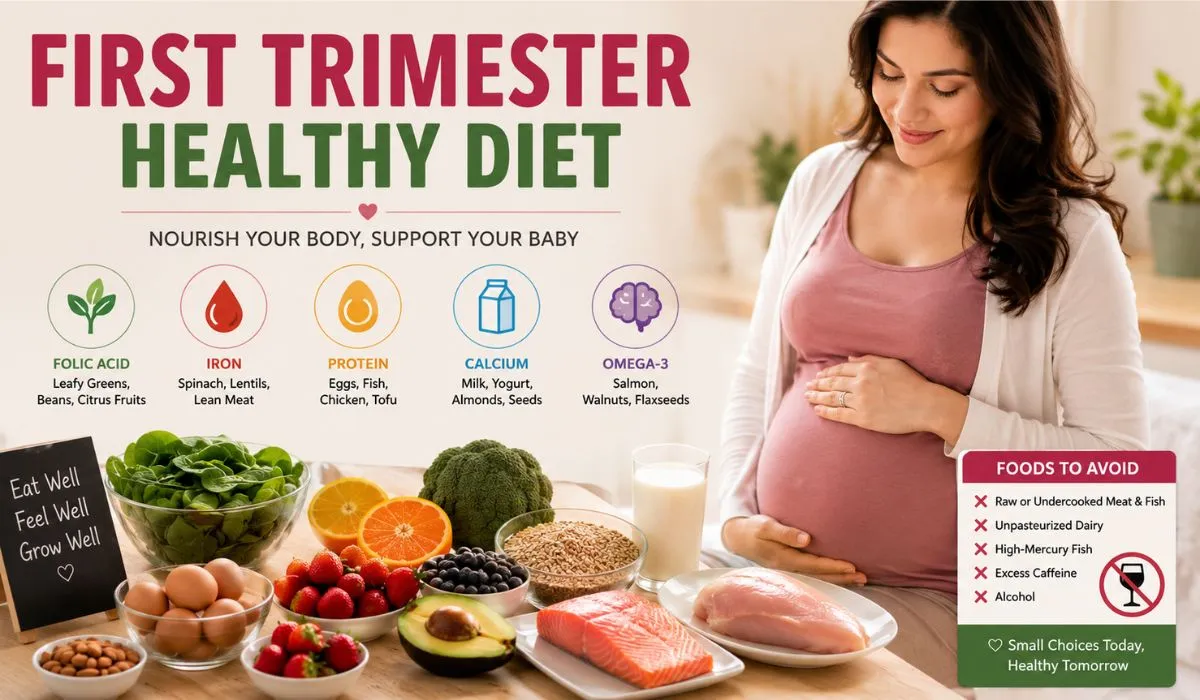
Folic acid is the one that genuinely can’t wait around. Doctors will often tell you to start it before you’re even actively trying, because the neural tube — which eventually becomes your baby’s brain and spinal cord — forms in these very first weeks, sometimes before a test even shows a line. The CDC recommends 400 mcg of folic acid daily, starting before conception and continuing through early pregnancy, specifically to lower the risk of neural tube defects. Iron, protein, and DHA matter too, but folate is the one where the clock started running before you even knew.
The Nutrients Worth Actually Caring About
You don’t need to overhaul your whole diet overnight, and honestly, please don’t try. A handful of things are doing most of the real work right now.
Folate shows up naturally in lentils, spinach, citrus, fortified cereal — but let’s be real, your prenatal vitamin is carrying most of that weight already. Most cover ACOG’s recommended 400–600 mcg range, so food is more of a top-up than the main event.
Iron needs start rising early, because your blood volume is quietly expanding to support the pregnancy. Red meat, beans, leafy greens all help. Here’s a small trick worth knowing: pair iron-rich food with something high in vitamin C — orange slices next to a spinach salad, say — and your body absorbs noticeably more of it.
DHA, an omega-3, is working in the background on your baby’s brain from the very start. Salmon or sardines a couple times a week is the textbook move, but if fish is the last thing you want anywhere near you right now (fair — week 7 does that to people), an algae-based DHA supplement gets you to the same place, minus the smell.
And don’t underrate protein. Eggs, Greek yogurt, nut butters — these tend to go down easier than a full meal, and keeping your blood sugar steadier can genuinely take the edge off nausea for a lot of women.
When Nausea Makes Any of This Feel Impossible
Let’s be honest about the real obstacle here: morning sickness does not care about your meal plan. Whoever came up with “just eat balanced meals” clearly never met week 8 nausea in person.
What actually helps, more often than not: smaller meals, more frequently, so your stomach’s never fully empty or overly full. Cold or room-temperature food, since hot meals carry stronger smells that can set things off. And ginger — tea, chews, whatever form you can stand — which has real evidence behind it, not just old-wives’-tale status. On the days when even the sight of a vegetable turns your stomach, let it go, completely. Your prenatal vitamin exists exactly for days like this.
And if you truly can’t keep anything down for more than a day or two, call your provider instead of white-knuckling through it. Hyperemesis gravidarum is real, it’s treatable, and there’s no prize for toughing it out solo.
Foods Worth Steering Clear Of
Shorter list than most people expect: alcohol, raw or undercooked meat and eggs, unpasteurized dairy, high-mercury fish like swordfish or king mackerel, deli meat unless it’s reheated until steaming. Health experts are firm on these — this is one of the few spots worth treating as non-negotiable, not “try to avoid when possible.” Coffee, though, isn’t off the table. ACOG’s general guidance is to stay under 200 mg of caffeine a day, roughly one 12-ounce cup.
The Honest Takeaway
You don’t need a rigid meal plan for these twelve weeks, and you really don’t need to feel guilty about the days that don’t go the way you planned. Let your prenatal vitamin be the safety net it’s built to be. Lean into folate- and iron-rich foods on the days your body’s cooperating. And on the days it’s toast and ginger ale for dinner, again — that’s not a diet failure. That’s just what early pregnancy actually looks like for a lot of people, way more often than the polished pregnancy-nutrition posts ever let on.
FAQ
Do I need to eat more calories in the first trimester?
Not really. Most women need roughly the same calories as before pregnancy, maybe up to 100 extra a day by the end of the trimester. The real shift is in nutrient quality, not quantity.
What if I can’t keep vegetables down because of nausea?
Lean on your prenatal vitamin and gentler options — fruit, smoothies, fortified cereal — until the nausea eases, usually by week 12–14.
Is it safe to take a prenatal vitamin on an empty stomach?
It’s usually easier on your stomach with a small snack alongside it. If mornings are rough, try taking it at night instead.
Can I still drink coffee in the first trimester?
Yes, in moderation. ACOG’s guidance is under 200 mg of caffeine a day, about one 12-ounce cup.
What foods should I avoid completely in early pregnancy?
Alcohol, unpasteurized dairy and juice, raw or undercooked eggs and meat, and high-mercury fish — and that holds for the whole pregnancy, not just the first trimester.