

You open the fridge. You stare at it for a while. You close it again. Nothing in there looks good — not the leftovers, not the fruit, not even the thing you were craving yesterday. Sound familiar?
Table of Contents
First off — you’re okay. This is way more common than anyone warns you about, and it doesn’t mean anything’s wrong with you or the baby. Your body’s just busy doing a hundred other things right now, and eating has fallen off the priority list for a bit. Let’s get into why, and what actually helps.
Why does pregnancy kill your appetite like this?
Feels backwards, right? You’re growing a whole person — shouldn’t you be hungry constantly? Turns out, not always.
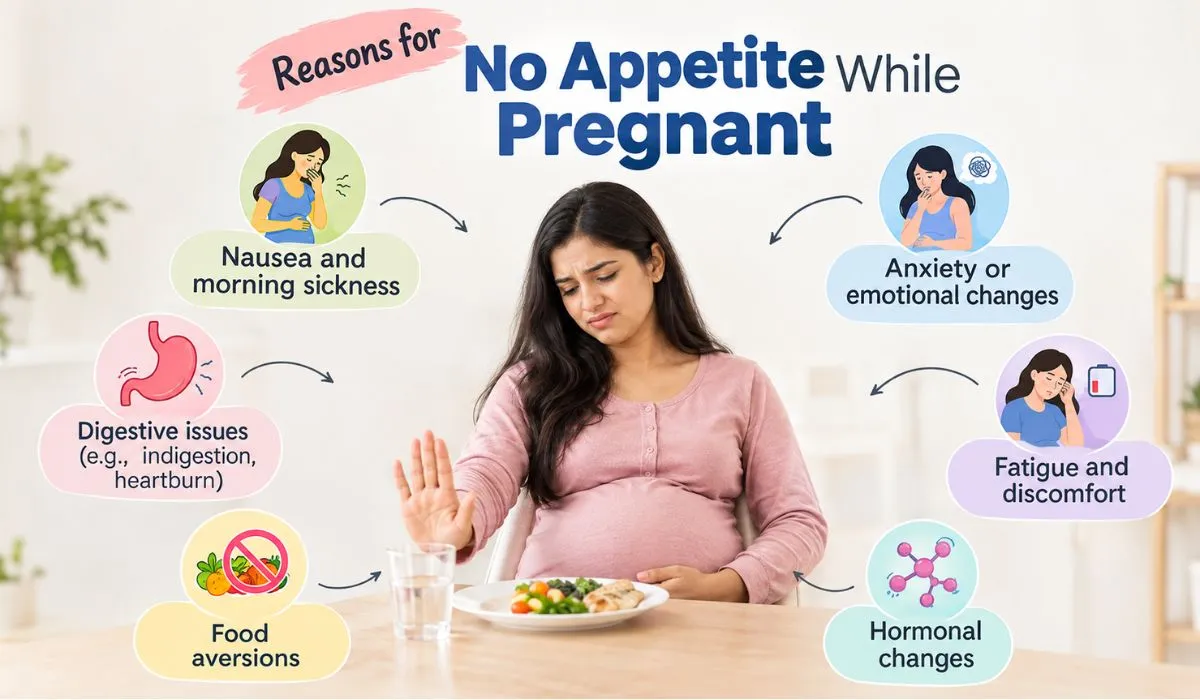
A big chunk of it comes down to hormones. Progesterone and hCG spike and slow digestion way down, so you can feel oddly full even when you haven’t eaten a thing all day. Then nausea shows up and makes everything worse — and morning sickness isn’t just the throwing up part, it’s that dread that creeps in before you’ve even taken a bite.
Your nose probably feels like it’s got superpowers too. Coffee, leftovers, your partner walking by in cologne — stuff that never used to register can suddenly send you bolting from the room. Throw in exhaustion and stress quietly muting your hunger cues, plus a growing belly leaving your stomach less room to work with as pregnancy goes on, and yeah — eating starts to feel like a whole production instead of something you just do.
Should you actually be worried?
Here’s the reassuring bit: a few weeks of “eh, not hungry” is totally normal, especially in the first trimester. For most women, appetite quietly wanders back once the second trimester hits.
But there’s a point where it’s worth a call. If you’re dropping weight instead of gaining, can’t hold down food or water at all, or this is still going strong well past twelve weeks — get your doctor on the phone. According to ACOG, that combo can point to hyperemesis gravidarum, which is a step up from typical morning sickness and genuinely needs medical care. Don’t try to white-knuckle through that one alone.
Okay, so what actually helps?
Throw out the idea of three full meals a day for now — that’s not realistic when your appetite’s gone AWOL. Small and often beats big and forced, every time.
Go snack-sized: a few crackers, half a banana, a spoonful of yogurt, every couple of hours. It adds up more than you’d guess, and it’s way less daunting than a full plate. Plain and bland tends to sit best — toast, rice, dry crackers, nothing swimming in sauce or reeking of anything strong. And here’s a weird one: cold or room-temp food is often way easier than hot food, mostly because it’s not filling the kitchen with smell the second you open it.
Keep ginger nearby too — tea, candy, even ginger ale with actual ginger in it. It really does take the edge off. And don’t skip water. It’s shockingly easy to mistake dehydration for “just not hungry,” so keep sipping water, coconut water, or an electrolyte drink throughout the day.
If your prenatal vitamin seems to be making things worse, tell your doctor. Sometimes just switching brands, or taking it at night with a small snack instead of first thing in the morning, fixes the whole problem.
Things to skip
Don’t skip meals entirely just because nothing sounds good — an empty stomach usually makes the nausea worse, not better. Don’t force down a big plate either when you’re clearly not up for it; that one tends to come back up. And please don’t quietly stop your prenatal vitamins on your own. They matter — folic acid especially — so if they’re the issue, talk to your provider about swapping instead of just skipping them.
When to actually pick up the phone
Call your doctor if you can’t keep anything down for over a day, you’re losing weight instead of gaining it, you’re feeling lightheaded or faint, or your urine’s gone dark and infrequent. Those are your body’s way of saying it needs more help than a few food tweaks can give.
Quick answers to what you’re probably wondering
Is it normal to have zero appetite in the first trimester?
Yep, totally normal. Blame the hormones and nausea — it usually eases up by the second trimester.
What should I eat if literally nothing sounds good?
Keep it small and plain — crackers, toast, yogurt, half a banana. Nothing fancy required.
Could this actually hurt my baby?
A rough week or two usually isn’t a problem. Ongoing loss with weight loss or dehydration is what warrants a call to your doctor.
Do prenatal vitamins make it worse?
They can, especially taken on an empty stomach. Try it with a snack or right before bed instead.
When does the appetite actually come back?
Most women start feeling like themselves again around the second trimester, once hormones settle.