
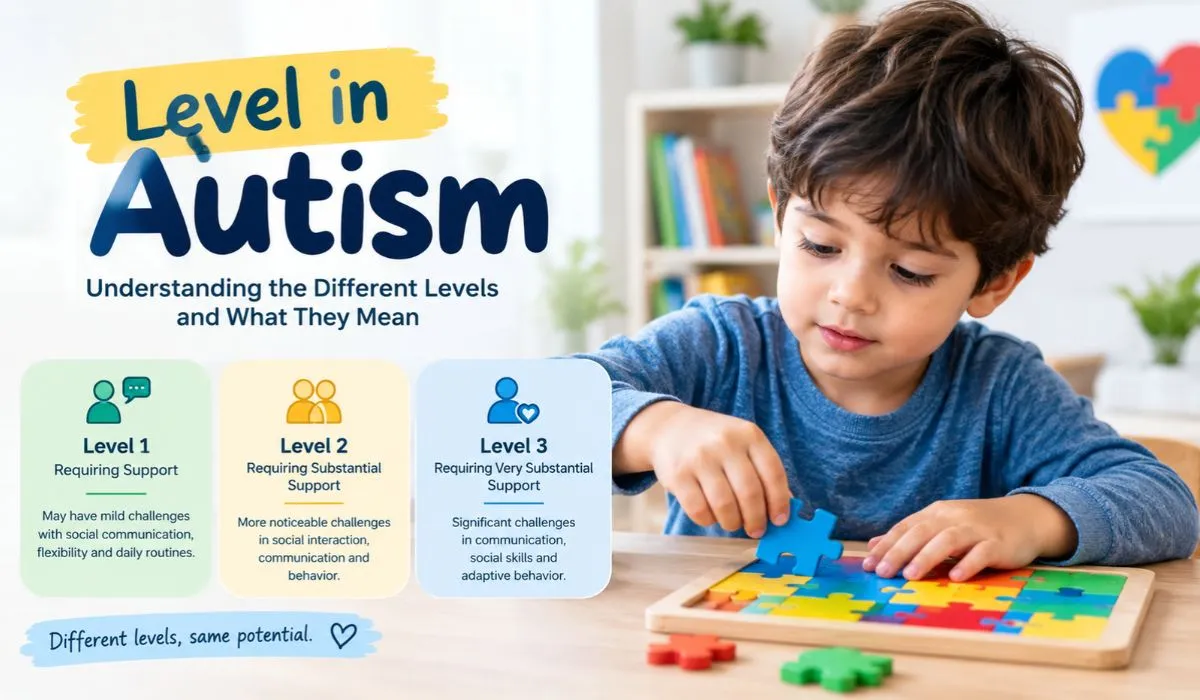
Autism levels show how much support a person needs in everyday life. There are three. Level 1 needs support, Level 2 needs substantial support, and Level 3 needs very substantial support. They don’t measure intelligence, and they don’t rank how “serious” autism is.
Table of Contents
Let’s clear up the biggest mix-up
Here’s what I hear most. “So Level 1 is the mild one, right?” Kind of, but not really. And that “not really” matters.
Doctors don’t use levels to grade a child. They use them to describe help. They look at how hard social communication is, and how strongly a child needs repeated habits or fixed routines, and then they ask a simple thing: how much support would make daily life work? The CDC says about 1 in 31 children is identified with autism today. That’s a lot of families asking this same question.
Level 1, in real life
Picture a child who talks well, maybe too well about dinosaurs, but can’t figure out how to join other kids at recess. Jokes confuse them. A new classroom can feel like the ground moved. A lot of Level 1 kids hold it together at school, then melt down at home, because all that “acting normal” is exhausting. People call it masking, and it’s more common than you’d think.
Level 2, in real life
Now picture a child who speaks in short phrases and mostly about one favorite thing. They don’t read faces or tone very well. They flap their hands, line up toys, or need the same routine every morning. Others notice the differences quickly. Therapy, classroom help and a calm routine at home really make a difference here.
Level 3, in real life
A child at this level may speak very little, or not at all. They usually need an adult close by for eating, dressing and bathing, and a change in routine can feel huge. But please don’t write them off. With patient therapists, teachers and family, many of these children keep learning, and they show joy and personality in their own way.
One more thing, levels can shift
A level isn’t a life sentence. A child diagnosed at four might need much less help by ten. Some go the other way during a rough year. That’s normal, and it doesn’t mean anyone failed.
And try not to say “high-functioning” or “low-functioning.” Experts, including the NIH, lean away from those terms. A quiet Level 1 child may be struggling a lot, while a Level 3 child may be brilliant at music or puzzles.
When to talk to a doctor
Early help usually works best, so watch for the early signs. Little eye contact, not turning when you say their name by around 12 months, and late speech are common ones. A single sign doesn’t mean autism. But if it keeps bothering you, call your pediatrician and ask for a developmental screening. Waiting rarely helps.
Many moms also ask me, quietly, if they caused it. No. Autism has many causes, and genes play a big role. Research does suggest enough folic acid and good prenatal nutrition support healthy brain development, so prenatal care matters for every baby. It just isn’t a pass-or-fail test.
A few practical things
Ask for a full evaluation. Keep notes on what you see at home. Look into early intervention programs near you. And go easy on yourself, because nobody gets handed a manual.
Quick questions
What are the 3 levels of autism?
Level 1 needs support, Level 2 needs substantial support, Level 3 needs very substantial support.
Is Level 1 autism mild?
Not exactly. It needs less support, but daily life can still be hard.
Can the level change?
Yes. Age, therapy and life changes can all shift it.
Who decides the level?
A trained specialist, like a developmental pediatrician or psychologist, after a full evaluation.
Does the level show how smart someone is?
No. It’s about support, not IQ.