
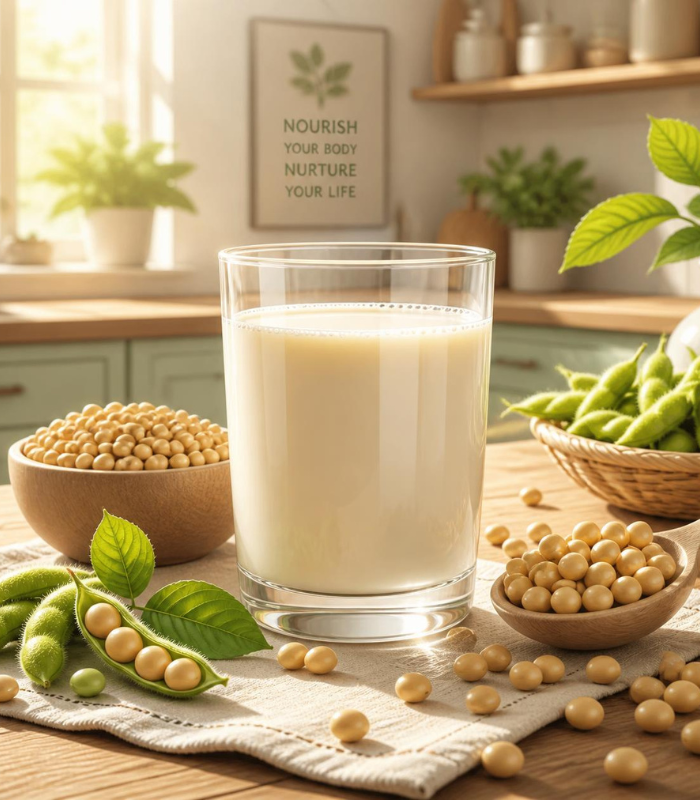
I remember googling this at 11 p.m., propped up on pillows because lying flat had started giving me heartburn, and landing on a forum post about soy “messing with hormones during pregnancy.” I put my soy milk latte down like it had personally wronged me. It took me an embarrassingly long time to actually read past the scary headline and into the studies themselves — and once I did, the picture looked nothing like the panic I’d worked myself into.
Soy milk is generally considered safe in pregnancy in normal dietary amounts — a serving or two a day — and it’s nutritionally one of the closest plant-based matches to cow’s milk you can buy. Let me walk you through what actually turned my anxiety down.
Table of Contents
Where the fear actually comes from — and where it doesn’t apply to you
Soy contains isoflavones, plant compounds that can weakly bind to estrogen receptors. That part of the scary headline is technically true. What it leaves out is where the concerning findings actually come from: almost entirely from animal studies using very high, isolated doses, and from infant soy formula, where isoflavone exposure relative to body weight is dramatically higher than anything an adult gets from food, and where a developing hormonal system is more sensitive to begin with.
A pregnant adult drinking a cup of soy milk with breakfast is simply not in either of those categories. Human research on typical dietary soy intake in pregnancy hasn’t shown the same red flags as those high-dose or infant-formula studies — that distinction is the whole thing the alarmist articles skip.
There’s actually research pointing the other direction from what I expected: higher dietary soy isoflavone intake during pregnancy has been associated with a lower risk of hyperemesis gravidarum — severe pregnancy nausea and vomiting. That’s the opposite of a red flag, and it’s not something I saw mentioned anywhere in that late-night forum spiral.
What it actually gives you nutritionally
This was the part that made me feel silly about pouring my latte down the drain. Soy milk has real protein — commonly around 7-8 grams per cup, genuinely close to dairy milk, which almond and oat milk simply can’t claim. It’s cholesterol-free, carries antioxidant compounds, and is typically fortified with calcium. It’s a good enough source that I list it alongside other protein-rich foods for pregnant women rather than treating it as just a beverage.
What “moderation” actually means in practice
Most guidance lands around a serving or two of soy foods a day, counted collectively — so a cup of soy milk in your coffee plus tofu at dinner is a completely normal, fine day. If you want more ways to fit it in between meals, edamame shows up a lot in my healthy pregnancy snacks list. That’s not something to ration down to the point of stress, and if soy has always been part of your normal diet, there’s no strong reason to change that just because you’re pregnant now.
The one minor thing worth knowing (that isn’t actually about soy specifically)
Some research has flagged trace cadmium in soy foods, particularly tofu. It’s worth knowing, but it’s not unique to soy — shellfish and other legumes carry trace amounts too, and avoiding every food with trace cadmium would mean cutting a long list of genuinely nutritious foods. It’s not a reason to avoid soy; it’s a reason to eat a variety of protein sources generally, which is good general-purpose advice regardless.
Soy vs. almond vs. cow’s milk
| Protein | Calcium | Phytoestrogens | |
|---|---|---|---|
| Soy milk (fortified) | High, closest to dairy | High (fortified) | Present, at food-level amounts |
| Almond milk (fortified) | Very low | High (fortified) | Minimal |
| Cow’s milk | High | Naturally high | None |
If protein matters to you and dairy isn’t an option, soy is genuinely the stronger substitute over almond milk — it’s not just a lighter beverage, it’s an actual protein source.
What I still check on the carton
- Pasteurized, always
- Fortified with calcium and vitamin D — check the label, not the marketing
- Unsweetened, if I’m watching sugar
What I’d tell you, standing in that dairy aisle at 11 p.m. with me: if soy milk is something you genuinely enjoy, there’s no research-based reason to cut it from a normal, varied pregnancy diet. A cup or two a day, alongside other protein and calcium sources, is a reasonable and well-supported choice. If you have a personal or family history of a hormone-sensitive condition, that’s a specific, worthwhile question for your OB — not because soy is dangerous, but because your situation may call for individualized guidance rather than the general answer.
I went back to my latte the next morning. I just don’t spiral over it at 11 p.m. anymore — and I’ve got a few more soy-milk-friendly ideas over in my breakfast during pregnancy guide if you’re looking to build a whole morning around it.
By Emma Gill
 Alona Smith