

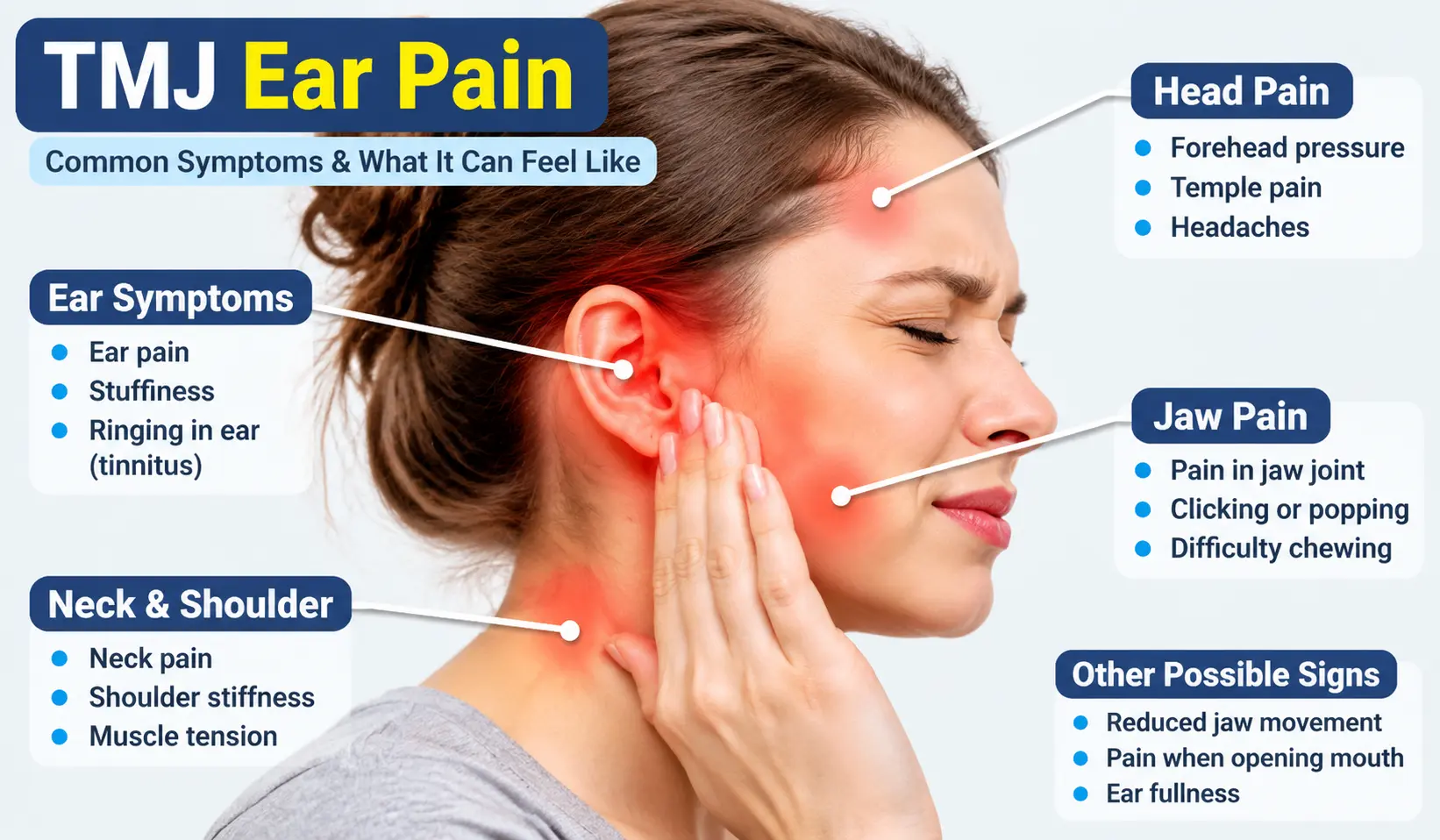
Struggling with ear pain but no infection? Learn how TMJ dysfunction causes ear pain, which exercises can help, and when it’s time to see a professional.
Table of Contents
6 min read
You wake up with a tight jaw, a dull headache, and an ear that aches for no obvious reason. No cold, no congestion, no infection. So what gives?
If this sounds familiar, there’s a good chance your jaw is the culprit. Ear pain that lingers without a clear cause is one of the most common signs of temporomandibular joint (TMJ) dysfunction, and it catches a lot of people off guard.
In this guide, we’ll walk through:
- Why TMJ problems so often show up as ear pain
- The most common causes
- How to tell whether your jaw is involved
- Simple exercises that can ease symptoms
- When it’s time to get expert help
Understanding TMJ and Ear Pain: What’s the Connection?
What Is the TMJ?
The temporomandibular joint is the hinge that connects your lower jaw to your skull, sitting just in front of each ear. You have one on each side, and together they let you talk, chew, yawn, and open and close your mouth hundreds of times a day.
Temporomandibular disorders (often shortened to TMD) happen when the joint, the muscles around it, or the way the jaw moves isn’t working smoothly. The result can be pain in the jaw, face, head, neck, and very often, the ear.
Why Does It Feel Like It’s in Your Ear?
Your jaw and ear are close neighbors, and they share more than just space. Here’s why TMJ trouble can feel like an ear problem:
- Proximity. The joint sits right beside the ear canal, so inflammation or irritation there is easily felt as ear pain.
- Shared nerve pathways. The muscles that move your jaw, including the masseter, temporalis, and pterygoids, share nerve supply with structures around the ear, which can cause referred pain.
- Pressure and fullness. Tight jaw muscles may affect how the ear feels, creating a sense of fullness, muffled hearing, or pressure similar to a blocked ear.
It’s not unusual for people to be treated for an ear infection more than once before anyone considers the jaw.
Common Causes of TMJ-Related Ear Pain
If you notice clicking, tightness, or an ache near the jaw or ear, one or more of these may be at play.
1. Clenching and Grinding
Many people clench their jaw or grind their teeth (bruxism) without realizing it, often during sleep or while concentrating. Over time, the muscles become overworked, tender, and tight.
2. Forward Head Posture
Hours on a phone or laptop tend to push the head forward. That shift changes the resting position of the jaw and loads the muscles and joint in ways they weren’t built to handle all day.
3. Stress
Stress loves the jaw. Many of us tense up, hold our breath, or clench when we’re under pressure, and flare-ups often track with stressful stretches of life.
4. Joint or Disc Problems
Sometimes the joint itself isn’t tracking smoothly. A displaced disc, arthritis, or an uneven bite can all lead to irritation and uneven muscle use.
5. Injury or Dental Changes
A blow to the jaw, whiplash, major dental work, or missing teeth can change how the jaw moves and strain the joint.
How to Know If Your Jaw Is Causing Your Ear Pain
The overlap between jaw pain and ear problems means it isn’t always obvious. A few clues point toward TMJ:
- Ear pain that doesn’t improve with antibiotics or allergy treatment
- Clicking, popping, or catching when you open or close your mouth
- Pain that gets worse when you chew, yawn, or talk
- Headaches, facial tension, or neck stiffness alongside the ear discomfort
- Tenderness when you press just in front of the ear
- A jaw that feels stiff or tired, especially in the morning
It’s worth having a doctor rule out an actual ear infection or other ear condition first, particularly if you have fever, discharge, or hearing loss. If the ear checks out clear, the jaw becomes the next place to look.
TMJ Ear Pain Relief Exercises
Gentle, consistent movement can help calm irritated muscles and teach the jaw to move more efficiently. These exercises are general guidelines, not a replacement for individualized care. If you feel sharp pain, dizziness, or your symptoms get worse, stop and check in with a professional.
1. Controlled Jaw Opening
This builds awareness and helps the jaw open in a smooth, straight line.
- Rest the tip of your tongue on the roof of your mouth, just behind your front teeth.
- Slowly open your mouth as far as is comfortable, keeping your tongue in place.
- Hold for 3 seconds, then close slowly.
- Repeat 5 to 10 times.
2. Masseter Massage
The masseter is the big chewing muscle in your cheek, and it’s often the tightest one.
- Locate the muscle along your cheek, just in front of and below your ear.
- Use two or three fingers to apply gentle circular pressure.
- Continue for 1 to 2 minutes on each side.
Some tenderness is normal. Keep the pressure comfortable and never push into sharp pain.
3. Chin Tucks
Chin tucks help reset head posture and take pressure off the jaw.
- Sit or stand tall with your shoulders relaxed.
- Gently draw your chin straight back, as if making a soft double chin, while keeping your jaw relaxed.
- Hold for 5 seconds.
- Repeat 10 times.
4. Neck Side Stretch
Tight neck muscles can tug on the jaw, so loosening them often helps.
- Sit tall and tilt your ear toward your shoulder.
- Use your hand to add very light pressure.
- Hold for 20 to 30 seconds, then switch sides.
5. Diaphragmatic Breathing
Shallow chest breathing keeps the neck and jaw on high alert. Slow belly breathing tells your body it can let go.
- Lie on your back with your knees bent.
- Place one hand on your chest and one on your belly.
- Breathe in through your nose so that mainly your belly rises.
- Exhale slowly through your mouth.
- Continue for about 5 minutes.
The real secret is consistency. A few minutes a day usually beats one long session a week.
Everyday Habits That Help
Exercises work best alongside small daily changes:
- Rest your jaw. Aim for lips together, teeth apart, tongue resting gently on the roof of your mouth.
- Watch for clenching. Notice it while driving, working, or exercising, and let your jaw drop.
- Go easy on your jaw. Skip gum, avoid biting nails, and cut very hard or chewy foods while symptoms are flaring.
- Use warmth. A warm compress on the jaw for 10 to 15 minutes can relax tight muscles.
- Check your setup. Keep your screen at eye level so your head stays over your shoulders.
- Manage stress. Walks, breathwork, stretching, and good sleep all help.
When to Get Professional Help
Self-care is a great starting point, but it isn’t always enough. Consider seeking help if:
- Your pain lasts more than a couple of weeks or keeps coming back
- Your jaw locks, or you can’t open it fully
- Eating, sleeping, or working is getting harder
- You have significant swelling, fever, or sudden hearing changes
- Exercises make your symptoms worse
A physical therapist, dentist, or doctor familiar with TMD can look at the full picture: jaw movement, neck mobility, posture, breathing, bite, and stress patterns. Treatment often combines manual therapy, movement retraining, guided exercise, and sometimes a night guard, and it’s tailored to what’s actually driving your pain.
The Bottom Line
Ear pain doesn’t always start in the ear. When it comes with jaw tension, clicking, headaches, or neck tightness, TMJ dysfunction is a likely suspect, and the good news is that it often responds well to the right combination of exercises, habit changes, and professional guidance.