

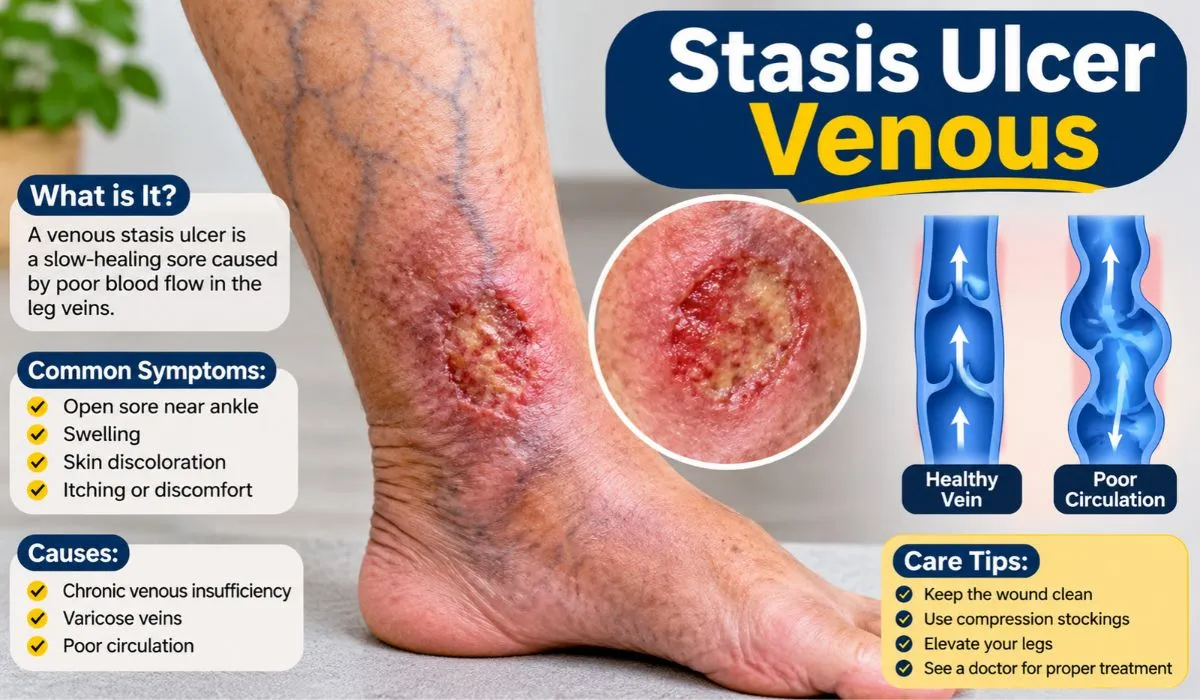
A stasis ulcer venous condition is an open sore, usually on the lower leg, that is slow to heal because of poor blood flow in the veins. It is the most common cause of leg ulcers, accounting for about 80 percent of them, and affects roughly 1 percent of people in the United States. It is more common in women and older adults. A stasis ulcer venous sore can linger for weeks, months, or even years, but with the right care most people heal well.
Table of Contents
What Is a Stasis Ulcer Venous Condition?
Your leg veins contain tiny valves that snap open and shut to push blood back up toward your heart, working against gravity. When those valves are damaged or weak, or when a vein is blocked, blood doesn’t flow upward as it should. It pools in the lower leg and raises pressure inside the veins, a problem doctors call venous hypertension.
Over time, that pressure damages the surrounding tissue. Inflammation sets in, tiny blood vessels are injured, and the skin eventually breaks down into an ulcer. Because the problem starts with circulation, treating only the wound isn’t enough. The underlying vein problem has to be addressed too.
Who Is Most at Risk for a Venous Stasis Ulcer?
Anyone can develop venous insufficiency, but certain factors raise the odds:
- Older age
- Obesity
- A previous leg injury
- A history of deep vein thrombosis (DVT) or phlebitis
- Varicose or spider veins
- A family history of vein disease
- Smoking
- A sedentary lifestyle, or limited mobility such as paralysis
- Past surgery such as a knee replacement
Symptoms: What Does a Stasis Ulcer Venous Sore Look Like?
A stasis ulcer venous sore usually appears on the lower leg, often near the inner ankle. It tends to be shallow and irregularly shaped, and the surrounding skin is often discolored, hardened, or thickened. Other signs include:
- A dull ache or heaviness in the leg
- Swelling that improves when you raise your leg
- Itching or eczema-like skin changes
- Fluid or pus draining from the sore
- A foul odor
If an ulcer keeps coming back in the same spot, that is a strong clue that the veins are the cause.
Why Diagnosis Matters
Not every leg sore is a venous ulcer. Arterial ulcers, diabetic foot ulcers, and pressure sores can look similar but need very different treatment. Finding the true cause is the first step.
Diagnosis is often clinical: a provider examines your leg and asks about your history. If the picture is unclear, tests can help:
- Ankle-brachial index (ABI): compares blood pressure in your arms and legs
- Duplex ultrasound or Doppler study: shows how blood is moving through your veins
- Other vein imaging: used in some cases to look for damaged valves or blockages
Don’t wait on an ulcer that isn’t healing. The longer it stays open, the greater the risk of infection, permanent tissue damage, and, in serious cases, loss of the limb. Large or long-standing ulcers are harder to heal, so early care makes a real difference.
How Is a Stasis Ulcer Venous Condition Treated?
The goals are to reduce swelling, help the ulcer heal, and prevent it from returning.
Compression therapy
Compression is the standard of care and has the strongest evidence behind it. It reduces swelling, improves blood flow, and speeds healing. Options include:
- Multilayer elastic bandages: more effective than single-layer wraps, though a trained professional usually applies them
- Graded compression stockings: tightest at the ankle and looser toward the knee, usually replaced about every six months as they lose their squeeze
- Unna boot: a zinc oxide bandage that hardens after application
- Intermittent pneumatic compression pumps: usually reserved for people who are bedridden and can’t tolerate other methods
Basic elastic wraps, like those used for sprains, don’t provide enough pressure. Compression isn’t safe for everyone, so people with significant arterial disease or uncontrolled heart failure should check with their doctor first.
Leg elevation
Raising your legs above heart level helps drain pooled fluid. The recommended routine is about 30 minutes, three or four times a day. That can be hard to fit into real life, but doing it consistently still helps.
Dressings
Dressings protect the ulcer and keep bandages from sticking to it. Studies haven’t shown that any one type is better than another, so the choice often comes down to cost, ease of use, and what works for you and your provider.
Medications
- Aspirin (300 mg daily in the studies) combined with compression has been shown to improve healing, as long as it’s safe for you.
- Pentoxifylline can help when added to compression, and may be an option for people who can’t tolerate compression.
- Antibiotics are used only when infection such as cellulitis is suspected. Routine use hasn’t been shown to speed healing.
Never start or stop a medication without talking to your provider.
Procedures and surgery
If a stasis ulcer venous sore is large, long-standing, or not responding to standard care, your provider may consider:
- Debridement to remove dead tissue
- Skin grafts or skin substitutes, which work best when the underlying vein problem is also treated
- Vein procedures, such as ablation of problem veins, to fix the root cause
Treating the underlying vein disease can lower the chance of recurrence, which is why many specialists recommend evaluating surgical options early for stubborn ulcers.
What Is the Outlook?
Ulcers present for three months or less have a 71 to 80 percent chance of healing, while chronic ones heal less often. Many people make a full recovery, but a stasis ulcer venous sore often returns, so prevention matters.
How to Prevent a Venous Stasis Ulcer
- Keep wearing compression stockings after healing if your provider recommends it
- Stay active, since walking helps your calf muscles pump blood
- Raise your legs when sitting for long periods
- Maintain a healthy weight
- Quit smoking
- Manage conditions like high blood pressure and diabetes
- Take blood thinners as prescribed if you’re at risk for clots
- Keep the ulcer and nearby skin clean while it heals
When to See a Doctor
Make an appointment if you notice a leg sore that isn’t healing, new swelling or skin discoloration, or itching that won’t go away. Get care promptly if you develop redness, warmth, increasing pain, pus, a bad smell, or fever, which can signal infection.
Final Thoughts
A stasis ulcer venous condition is slow to heal, but it is treatable. Compression, leg elevation, good wound care, and treating the underlying vein problem give most people the best chance of recovery and of keeping the ulcer from coming back. If you think you may have one, don’t wait: early evaluation leads to better results.