

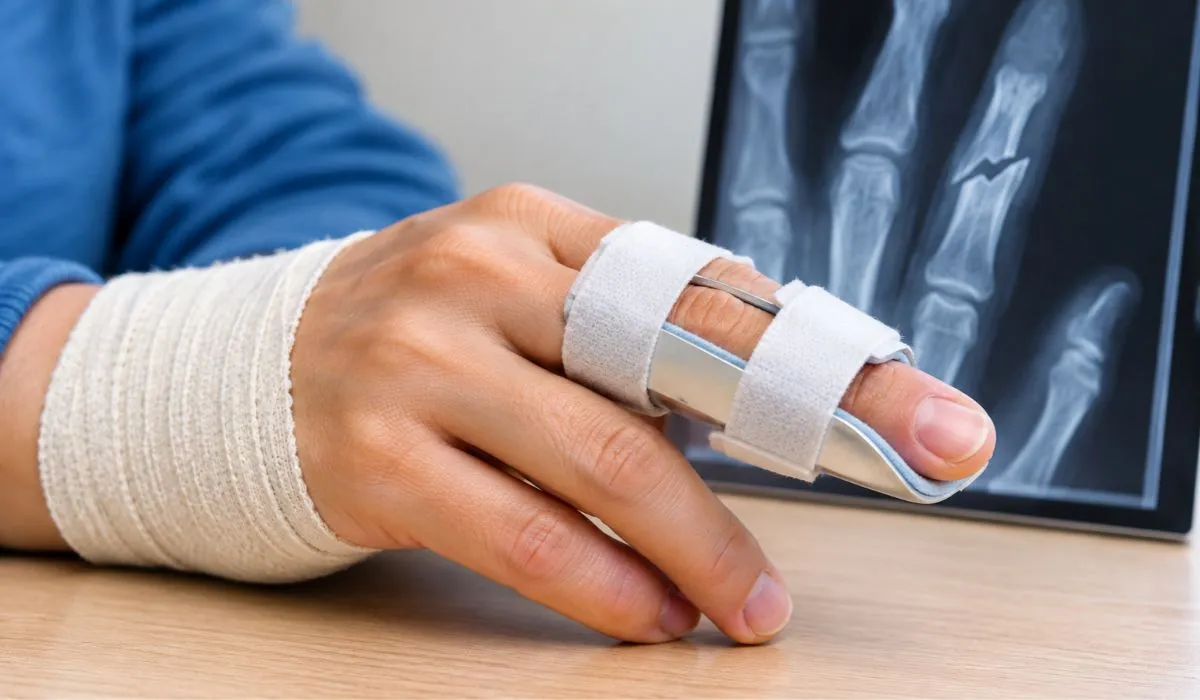
You slam your hand in a car door, catch a basketball the wrong way, or trip over the dog and land on your fingers. There’s a sharp jolt, then a throb that doesn’t fade, and you’re left staring at a finger that looks a little off. The big question hits right away: is it broken, or just badly bruised?
Table of Contents
It’s a common worry. Finger fractures are among the most frequent hand injuries, and the good news is that most heal well with simple treatment. The catch is that a poorly treated break can leave you with a stiff, crooked finger for years, so the first few days matter more than people think.
How to tell if your finger is actually broken
Pain alone doesn’t settle it, because a jammed or sprained finger can hurt just as much. A break usually brings a few extra clues. The swelling comes on fast and tends to be dramatic. The bruising may spread beyond the injured spot. The finger might look bent, twisted, or shorter than its neighbors, and trying to move it can feel impossible or nauseating. Some people hear or feel a crack at the moment of injury, though plenty of breaks happen quietly.
One honest caveat: you can’t reliably diagnose a fracture by looking at it, and even doctors need an X-ray to be sure. Some breaks are tiny hairline cracks that people walk around with for weeks, assuming it’s “just a sprain.” If the pain isn’t settling after a day or two, get it checked.
What to do in the first hour
Before anything else, take off any rings on that hand. Swelling can turn a comfortable ring into a tourniquet in minutes, and cutting one off later is a hassle you’d rather avoid.
After that, keep things simple. Hold the hand up above heart level to calm the swelling. Put a cold pack or a bag of frozen peas wrapped in a thin towel on the area for about 15 to 20 minutes at a time, never directly on bare skin. If you can, gently support the finger by taping it to the finger beside it, or by holding it against a popsicle stick or a folded piece of cardboard. The point is to stop it moving around, not to force it straight. Don’t try to pop a crooked finger back into place yourself. You can easily do more harm than good.
When it’s an emergency room situation
Most finger breaks aren’t emergencies, but a few signs mean you should go to urgent care or the ER right away:
- The finger is visibly bent, twisted, or pointing the wrong way
- You can see bone, or there’s an open wound over the injury
- The fingertip is pale, cold, bluish, or numb
- You can’t bend or straighten the finger at all
- The injury came from a crush, such as a heavy object or a door slammed hard
Even without those, it’s worth being seen within a day or so. Early treatment gives the bone its best shot at healing straight.
What the doctor will do
Expect a quick exam and an X-ray, sometimes from a couple of angles. The doctor will check whether the bone is lined up properly, whether the break runs into a joint, and whether the finger is rotated, which means it twists slightly when you make a fist and overlaps its neighbor.
For the majority of people, treatment is refreshingly low-tech. A stable break is often “buddy taped” to the next finger or held in a small splint for around three to six weeks. If the bone has shifted, the doctor may need to reset it first, usually after numbing the area.
Surgery enters the picture when the break is displaced and won’t stay put, when it damages a joint surface, when there are several fragments, or when the finger is rotated. In those cases, small pins, wires, screws, or plates hold everything in place while it heals. It sounds scarier than it usually is, and hand surgeons do these repairs all the time.
Two special cases are worth knowing about. A mallet finger happens when the very tip of the finger won’t straighten after a hit, often from a ball striking the fingertip. A jersey finger is the opposite: the tip won’t bend, typically after grabbing a jersey or something that yanks the finger away. Both involve tendons as much as bone, and both need prompt attention to heal properly.
How long recovery really takes
Most people are surprised by this part. The bone itself typically knits in about four to six weeks, but that’s not the same as being back to normal. Stiffness lingers. The joints near the break get cranky from being held still, and getting full movement back can take several more weeks or even a few months. Swelling can hang around for a surprisingly long time, especially at the knuckle.
Once your doctor gives the go-ahead, gentle movement is your best friend. Slowly bending and straightening the finger, making a loose fist, and squeezing a soft ball all help keep the joints from freezing up. If the stiffness isn’t improving, a hand therapist can make a big difference. Don’t rush it, though. Pushing hard too early can set you back.
As for pain, over-the-counter pain relievers are what most people use, but check with your doctor or pharmacist about what’s right for you, especially if you take other medications or have other health conditions.
What can go wrong
Most people heal without trouble, but it helps to know the possible hiccups. A bone that heals crooked, called malunion, can change how the finger looks and works. A bone that fails to heal, called nonunion, is rare but possible. Stiffness is the most common complaint by far, followed by lingering tenderness or a slightly bigger-looking knuckle. Smokers tend to heal more slowly, and so do people with certain conditions like diabetes. The best way to avoid problems is simple: get it checked, follow the splinting plan, and don’t skip the movement exercises once you’re cleared.
Can you prevent a broken finger?
Not entirely, because accidents are accidents. But a few habits help. Wear proper gloves for sports like baseball, softball, or goalkeeping, and use protective gear when you’re doing manual work. Be mindful with car doors, heavy lids, and gym weights. And if you do take a hit, don’t brush it off as “nothing” if the finger is still swollen the next day.
The bottom line
A broken finger is painful and annoying, but it’s one of the more fixable injuries out there. Take your rings off, ice and elevate it, support the finger, and get an X-ray. Then give it the time it needs, and put in the effort on those gentle exercises afterward. Your hands do a lot for you, so it’s worth treating them well.