

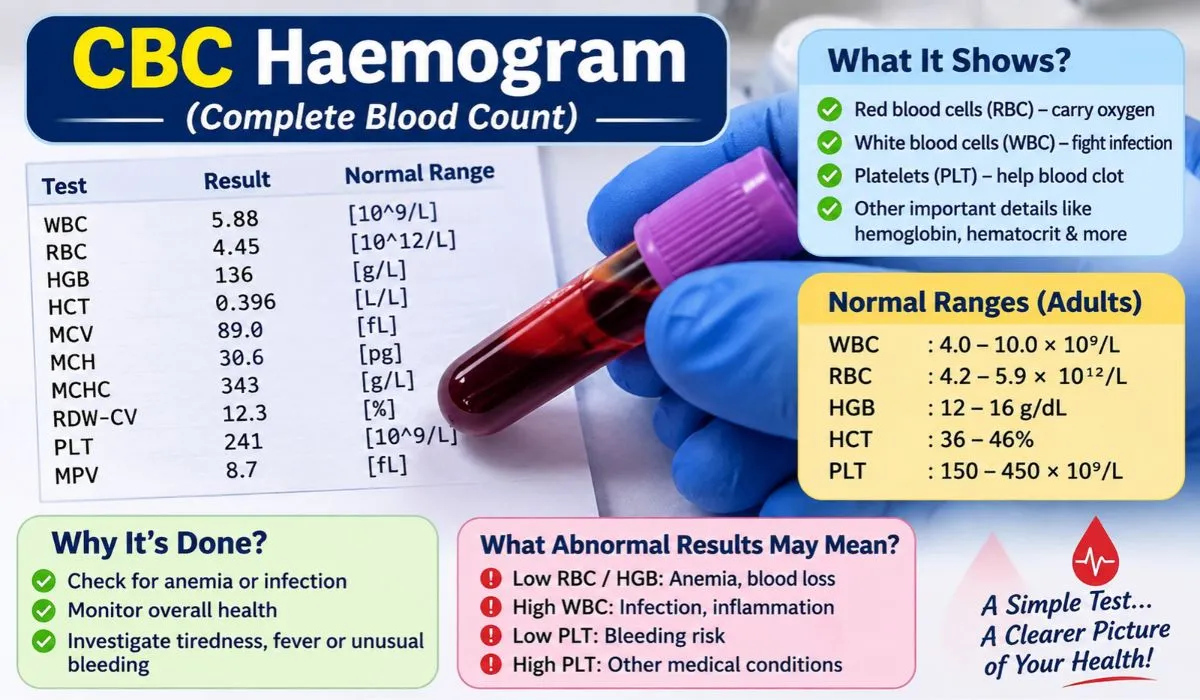
A CBC haemogram is a simple blood test that counts and measures the main cells in your blood: red blood cells, white blood cells and platelets. “Haemogram” is just another name for a complete blood count (CBC). Doctors use it to check your general health, spot infections or anemia, and see how your body is responding to a medication or a health condition.
If you’ve just been handed a lab slip full of abbreviations, take a breath. It looks more confusing than it is.
Table of Contents
What does a CBC haemogram actually check?
Think of your blood as a small team. Each cell type has a job, and the test checks whether the team is the right size.
Red blood cells carry oxygen around your body. Your report shows the red blood cell count, hemoglobin (the oxygen-carrying protein) and hematocrit (the share of your blood made up of red cells). When these run low, you may feel tired all the time or look pale. That’s what anemia feels like.
White blood cells are your defense crew. A high count often means your body is busy fighting an infection. A low one can mean your immune system is less able to cope. If your doctor orders a CBC with differential, the lab also counts the five types of white cells: neutrophils, lymphocytes, monocytes, eosinophils and basophils. Each fights something different, from bacteria to allergies.
Platelets help your blood clot. Too few, and you might bruise easily or bleed longer than usual.
Why would you need this test?
Plenty of reasons. It’s often part of a routine checkup. Doctors also order it when something feels off, like fever, unexplained weight loss, night sweats or constant fatigue. It’s also used to keep an eye on chronic conditions and treatments.
It’s especially common in pregnancy. Health organizations such as ACOG include blood counts in routine prenatal screening, because anemia is one of the most common issues for expecting moms. A CBC haemogram helps show whether your iron and folic acid levels are keeping up with what your body and baby need.
Do you need to prepare?
Usually not. You don’t need to fast for a CBC, and you can eat, drink and take your medicines as normal. The exception is when other blood tests are being done at the same time, since those may need fasting. Your provider will tell you.
The blood draw takes just a few minutes. Your arm might feel sore afterward, and a small bruise is common. Results usually arrive within a day or a few days.
What are normal CBC haemogram ranges?
According to Cleveland Clinic, typical adult ranges look like this:
- White blood cells: 4,000 to 10,000 per microliter
- Hemoglobin: 11.5 to 15.5 g/dL for females, 13 to 17 g/dL for males
- Hematocrit: 36% to 48% for females, 40% to 55% for males
- MCV (red cell size): 80 to 100 fL
- Platelets: 150,000 to 400,000 per microliter
Here’s the catch: ranges shift with the lab, your age, your sex, and whether you’re pregnant. Always compare your numbers to the reference range printed on your own report, not to a chart online.
What do abnormal results mean?
A number outside the range isn’t automatically bad news. Low red cell counts often come from iron deficiency, B12 deficiency or blood loss. A large MCV can point to a folic acid shortage, one reason folic acid matters so much before and during pregnancy. High white counts usually mean infection or inflammation. Living at high altitude can even raise your red cell count.
Serious causes exist too, which is why your doctor looks at the whole picture, including your symptoms, rather than one number. Out-of-range results may lead to follow-up tests, a treatment plan, or just monitoring.
Tips for making sense of your results
- Ask for a copy of your report and read the reference range beside each value.
- Mention every medicine, vitamin and supplement you take, since some affect blood counts.
- Don’t panic over one slightly high or low value. Ask what it means for you.
FAQs
Is a CBC haemogram the same as a CBC?
Yes. A hemogram is another name for a complete blood count.
Do I need to fast before a CBC haemogram?
Usually no. Fasting is only needed if other tests are done at the same time.
Can a CBC detect anemia?
Yes. Low red blood cells, hemoglobin or hematocrit can point to anemia.
How long do results take?
Typically a few days, sometimes 24 hours.
Does a CBC show kidney function?
Not directly. Your doctor may use it alongside other tests for a fuller picture.